Residential electrical service - Mesa, Arizona
Hot Tub Electrical Installation Mesa AZ and Pool Wiring Rules (2026 Guide)
What the City of Mesa's pool and spa checklist and brochure require for bonding, GFCI protection, panel capacity, clearances and barriers, and where the City's documents leave questions open.
Quick answer
Hot tub and pool electrical installation in Mesa follows the City's Swimming Pool and Spa Plan Submittal Checklist, and a new inground pool needs a City permit. The checklist requires an equipotential bonding grid, GFCI protection on all pool outlets and equipment, listed GFCI-protected underwater lights, and panel load calculations showing the service can carry the new equipment. The City's Pool and Spa Brochure adds a 6-foot setback between exterior outlets and the water edge, and barriers must pass inspection before plaster or water.
Hot tub electrical installation in Mesa, AZ is governed by more than a spa dealer's spec sheet. The City of Mesa publishes its own Swimming Pool and Spa Plan Submittal Checklist and a Pool and Spa Brochure, revised in August 2026, and together they set out what an inspector expects: equipotential bonding, ground-fault protection, a panel that can carry the load, clearances from outlets and overhead lines, and barriers that pass inspection before the water goes in.
This guide walks through those rules for homeowners adding a hot tub, building a pool or updating pool equipment. It explains where City of Mesa Electric or SRP comes into the picture, and it says plainly where the City's documents are silent. It is general information for single-family homes in Mesa.
Key takeaways
- The City of Mesa lists constructing or filling in an inground swimming pool as residential work that needs a permit.
- Mesa's pool and spa checklist requires an equipotential bonding grid, and the City's Pool and Spa Brochure calls for copper bonding of at least 8 AWG or rigid metal conduit.
- Mesa's checklist requires GFCI protection on all pool outlets and equipment, and underwater lights that are listed and GFCI-protected.
- Mesa's checklist says the primary electrical service panel must support the new pool or spa equipment and requires panel load calculations with the plans.
- The City's brochure sets a 6-foot minimum between exterior outlets and the pool water edge, while the checklist and the brochure give different overhead-line clearances of 10 feet and 22 feet 6 inches.
- Mesa requires a pool barrier at least 60 inches high with gate latch releases at least 54 inches above grade, inspected and approved before plastering or filling.
What does hot tub and pool electrical work in Mesa involve?
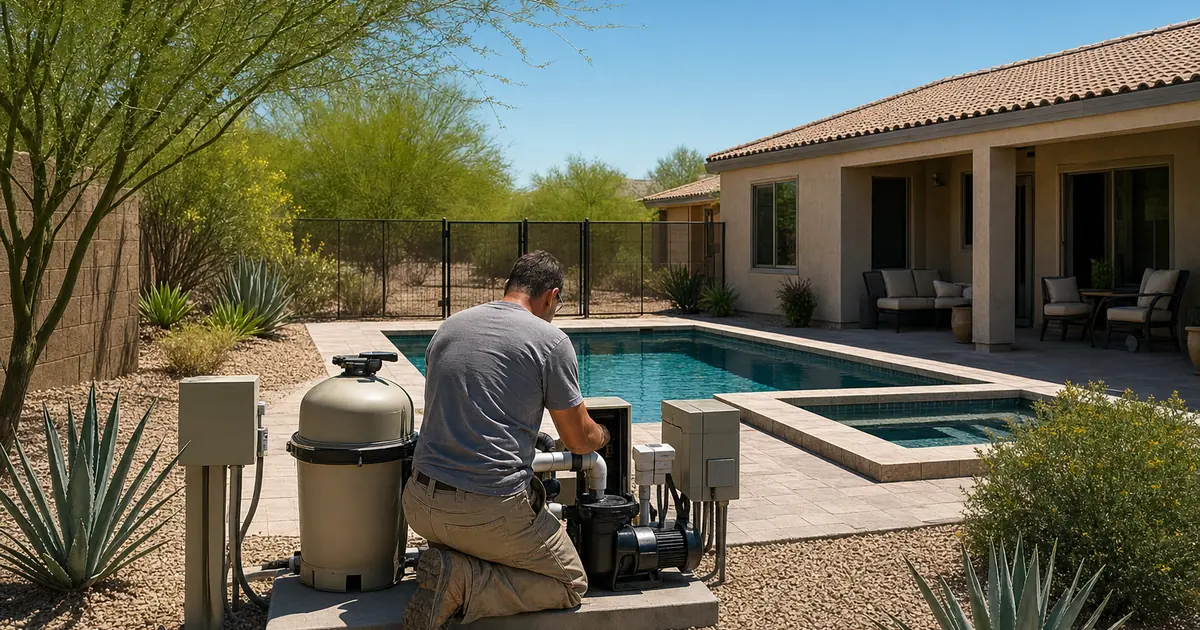
A pool or spa is one of the few places at home where people, water and electrical equipment meet directly. The electrical side of a project usually includes some or all of these pieces:
- Equipment circuits. Branch circuits or a feeder to the pump, filter, heater, chlorinator, blower or a packaged hot tub, each with a breaker and wire sized to the equipment.
- Bonding. A conductor that ties the pool shell's steel, metal fittings, the pump motor and nearby metal together, which the City checklist calls an equipotential bonding grid.
- Ground-fault protection. GFCI protection on pool outlets, equipment and underwater lights.
- Lighting and receptacles. Underwater lights, deck and yard lighting, and the outlets around the equipment pad and patio.
- Controls. Timers and automation that decide when the pump runs, which matters on time-of-use electric plans.
- Panel capacity. Confirmation, by load calculation, that the home's service can carry the new equipment.
A pool electrician in Mesa is usually working alongside a pool builder or a spa dealer, and the order of work matters. The bonding grid goes in while the shell is still open, the circuits are run once the equipment pad is set, and the City has to see the barriers before plaster or water. On Mesa pool projects we often find that the builder, the spa dealer and the electrician have each been reading a different document, so we start from the City's own checklist and work backward to the equipment.
Mesa adopts the 2023 National Electrical Code with City amendments, which the City calls the Mesa Electrical Code. The City's building code page says the 2024 International Codes and the 2023 NEC apply to permit applications submitted on or after January 8, 2026, so a pool or spa permit applied for now is reviewed under that set.
Do you need a City of Mesa permit to wire a pool or hot tub?
For an inground pool, yes. The City of Mesa's residential construction page lists “Constructing or filling-in an inground swimming pool” among residential work that needs a permit, and the same page lists installing or modifying electrical systems as permit work. Permit Services can be reached at 480-644-4273 or PermitServices@MesaAz.gov. The City's Pool and Spa Brochure gives the same number for Development Services, Monday through Thursday, 7:00 a.m. to 6:00 p.m.
For a hot tub, the answer depends on what is being installed, and the City's documents do not settle every case. None of the Mesa pages read for this guide says whether a plug-in or above-ground spa on its own needs a permit. What they do show is that the brochure treats above-ground spas and hot tubs as their own category for barriers, and that a new hardwired circuit is a change to the home's electrical system. Our reading is that a new circuit to a spa is permit work, but the question for a specific tub should go to Permit Services before the spa is delivered.
For residential projects that go through plan review, the City says it returns written comments or an approval within 10 working days, with an expedited review of 5 working days available for an additional fee. Plan the spa delivery and the pool builder's schedule around that window.
The matrix below is our own arrangement of what each common pool or spa job touches in Mesa's paperwork and at the utility.
| Job | What the City text says about a permit | Mesa document to read | Utility angle | Our reading |
|---|---|---|---|---|
| New inground pool | Constructing an inground pool is listed as permit work | Pool and spa checklist; Pool and Spa Brochure | Pump and heater add load; time-of-use plans from either utility | One permit package covering bonding, circuits and barrier |
| Filling in an inground pool | Filling in an inground pool is listed as permit work | Residential construction page | Old equipment circuits must be made safe | Plan removal of pool circuits with the fill-in |
| New hardwired hot tub circuit | Installing or modifying electrical systems is listed as permit work | Pool and Spa Brochure (GFCI, hard cover option) | Spa heater adds load | Treat as permit work; confirm with Permit Services |
| Plug-in or portable spa | Not stated on the pages read | Pool and Spa Brochure (hard cover option) | Added load on an existing circuit | Ask Permit Services before delivery |
| New pool lights or outlets | Modifying electrical systems is listed as permit work | Checklist (listed, GFCI-protected lights); brochure (6-foot outlet rule) | None specific | GFCI and distance rules apply to the new work |
| Panel change for pool load | Modifying electrical systems is listed as permit work | Checklist (panel must support new equipment; load calculations) | Service change involves City of Mesa Electric or SRP | Run the load calculation before ordering equipment |
How we got this table. The second and third columns summarize the City of Mesa residential construction page (undated), the Swimming Pool and Spa Plan Submittal Checklist (undated) and the Pool and Spa Brochure (revised 08/2026), all read November 26, 2026. The utility and right-hand columns are our reading of how those documents apply to each job; they are not City interpretations, and Permit Services and the inspector decide. "Not stated" means the pages read do not answer the question. The table contains no prices because no public source sets one.
What does Mesa's pool and spa checklist require electrically?
The City's Swimming Pool and Spa Plan Submittal Checklist is the most useful single document for pool wiring in Mesa, because it ties each item to a code section. On the electrical side it says to “Provide equipotential bonding grid. (NEC 680.26; IRC E4204)” and that “All outlets and equipment shall be GFCI protected. (NEC 680.22; IRC E4207.2)” It adds that “Underwater lights shall be listed and GFCI protected. (NEC 680.23; IRC E4206.4)”
The checklist asks for paperwork as well as hardware. Plans must “Identify wire size and type, circuit breaker size, and burial depth for all electrical equipment. (IRC E3904)” The brochure repeats that plans show wire sizes and types, breaker sizes and burial depth, and adds that pools and spas must be bonded with copper of at least 8 AWG or with rigid metal conduit. The chart and table below put the City's electrical and barrier minimums side by side.
| Item | Mesa minimum | Source |
|---|---|---|
| Bonding | Equipotential bonding grid; copper 8 AWG minimum or rigid metal conduit | Checklist (NEC 680.26); Pool and Spa Brochure |
| Pool GFCI | All pool outlets and equipment GFCI-protected | Checklist (NEC 680.22) |
| Underwater lights | Listed and GFCI-protected | Checklist (NEC 680.23) |
| Exterior outlet to water edge | 6 feet minimum | Pool and Spa Brochure, rev. 08/2026 |
| Overhead conductors | 10 feet minimum (checklist); 22 feet 6 inches from the water line (brochure) | Checklist (NEC 680.8(A)); Pool and Spa Brochure |
| Barrier height | 60 inches minimum | Checklist (M-ISPSC 305.2.1 Exception 1) |
| Gate latch release | 54 inches minimum above grade | Checklist (ISPSC 305.3.3) |
| Barrier openings | Must not allow passage of a 4-inch sphere | Checklist (ISPSC 305.2.2) |
| Spa alternative | Hard safety cover that can be latched or locked (above-ground spas and hot tubs) | Pool and Spa Brochure |
How we got this table. Every value comes from the City of Mesa Swimming Pool and Spa Plan Submittal Checklist (undated) and the City of Mesa Pool and Spa Brochure (revised 08/2026), both read November 26, 2026. The overhead-conductor row shows both figures because the two documents state different clearances; we have not chosen between them. The 8 AWG figure is from the brochure. This is a transcription of City minimums, not measured data, and the inspector's decision governs.
The overhead-line row carries two figures because the two City documents give two. The checklist cites a 10-foot minimum under NEC 680.8(A); the brochure states 22 feet 6 inches from the water line. We do not pick one for you. Your electrician measures the actual lines over and near the pool and checks them against what the plans examiner applies to your permit.
Why does equipotential bonding matter so much around a Mesa pool?
Bonding is the part of pool wiring that homeowners rarely see and inspectors care about most. An equipotential bonding grid connects the pool's reinforcing steel, metal fittings, the pump motor and nearby metal so they sit at the same electrical potential. If a fault puts voltage on one of them, a swimmer touching the water and a metal rail at the same time should not find a voltage difference between the two. The City checklist requires the grid under NEC 680.26, and the brochure calls for copper no smaller than 8 AWG, or rigid metal conduit.
Bonding is not the same thing as grounding, and a GFCI does not replace it. A GFCI trips when it senses ground-fault current, meaning current leaking to ground, often because of moisture; bonding limits the voltage differences a person can touch. A safe pool has both.
Timing is the reason bonding mistakes are expensive. Much of the grid sits in or under the shell and deck, so it has to be installed and inspected while that work is still open. When we are asked to add a heater, a light or a new pump to an existing pool, we check that the bonding conductor at the equipment pad is present, intact and connected before we connect anything new, because a new motor tied into a broken bond leaves the original problem in place.
The CPSC, a national agency, says on its pool electrical safety page: “Since 2002, CPSC is aware of 33 fatalities that involved electrocutions in swimming pools and spas.” That is a national figure, and it is the reason the Mesa checklist treats bonding and GFCI protection as plan items rather than suggestions.
Can your Mesa home's electrical panel handle a pool or hot tub?
The City asks that question directly. The checklist says “Primary electrical service panel shall support new equipment.” and requires the applicant to “Provide electrical panel load calculations. (IRC E3603; E3602.2)” In practice the permit plans have to show that the home's existing service can carry the pump, heater, lights and any spa along with everything already in the house, or they have to show the upgrade that makes it possible.
Pool and spa equipment adds load in the season when a house is already drawing heavily. Air conditioning is usually among the largest loads in a home, and pool pumps run longest in summer; SRP's pool guidance puts summer run times at eight to 12 hours a day. A spa heater adds another large load on top of both.
On pool and spa jobs we run the load calculation before the equipment is ordered, not after. Equipment choices change the answer: a different pump, a different heater type or a spa with a different electrical rating can be the difference between fitting on the existing service and needing a larger one. When the calculation shows the service is too small, the job becomes a service upgrade with its own coordination with City of Mesa Electric or SRP; that process is explained on electrical panel upgrades in Mesa.
A separate question is where the spa's breaker and disconnect go. The manufacturer's installation instructions set the circuit requirements for a packaged hot tub, and the electrician matches the breaker, wire and GFCI protection to that nameplate and to the Mesa Electrical Code. A spa that ships with a cord, a spa that needs a hardwired circuit and an inground spa built with a pool are three different jobs.
How far do outlets, lights and overhead lines have to be from a pool in Mesa?
The City's brochure states: “Maintain a 6-foot minimum separation distance between exterior electrical outlets and pool water edge.” It also says “All exterior outlets shall be GFCI (ground fault circuit interrupter) protected.” That second line covers exterior outlets generally, not only those beside the pool, which is worth checking on any yard where outlets have been added over the years. For repairs or new receptacles around a patio, see outlet installation and repair in Mesa.
Underwater lights must be listed and GFCI-protected under the checklist. Deck and yard fixtures near the water belong in the same plan; if new lighting is going in around a pool, landscape lighting in Mesa covers the yard side of the work.
Overhead conductors are the clearance homeowners miss most often, because nobody looks up when choosing where a pool goes. As noted above, the checklist cites a 10-foot minimum under NEC 680.8(A) and the brochure states 22 feet 6 inches from the water line. The checklist adds that “Pool and pool equipment shall not be located within a public utility easement (P.U.E.).” Both points are settled at the design stage; moving a pool after it has been dug is not a realistic fix.
What barrier and gate rules affect a pool project in Mesa?
Barriers are not electrical work, but they control the schedule of every pool job and they exist for the same reason the wiring rules do. Mesa amends the swimming pool code to require a taller barrier than the base code: the checklist states “Barrier height shall be 60 inches minimum. (M-ISPSC 305.2.1 Exception 1)” and “Maximum openings in barrier shall not allow passage of a 4-inch-diameter sphere. (ISPSC 305.2.2)” Gates must self-close, self-latch and open outward away from the pool, and “Latch release shall be located 54 inches minimum above grade. (ISPSC 305.3.3)”
Where the house wall forms part of the barrier, doors to the pool area must be self-closing and self-latching and swing away from the pool, and the checklist states that “Sliding doors without self-closing, self-latching mechanism shall not form part of barrier. (M-ISPSC 305.4(2))” For hot tubs, the brochure offers an alternative: “Above ground spas and hot tubs may be equipped with a hard safety cover which can be latched or locked.”
According to the brochure, required barriers and safety devices have to be installed, inspected and approved before the pool is plastered or filled with water. The brochure also says pools built before April 20, 1998, are exempt unless the home is altered to add livable area or access to the pool, so an addition can bring an older pool's barrier under the current rules.
Mesa Fire and Medical explains why the City is strict. Its water safety page says drowning is the leading cause of accidental death for Arizona children ages 1 to 4 and, across all ages in Arizona, “the third most common cause of accidental death among all age ranges.” It asks families to “Ensure all doors and gates to the pool area are self-closing and self-latching and never prop them open.” National figures point the same way. In a June 2026 release, the CPSC says an average of 376 children under 15 fatally drowned in pool- or spa-related incidents each year from 2021 to 2023, and that over 70 percent of fatal drownings in that period occurred in residential settings. The CPSC's previous report, summarized by Pool Safely in July 2025, gave an average of 357 child deaths a year for 2020 to 2022, with 85 percent in a residential setting such as a backyard pool, and it recommended layered barriers including door alarms, pool covers, self-latching gates and fencing.
How do City of Mesa Electric and SRP rates affect running pool equipment?
Mesa homes buy electricity from one of two utilities. City of Mesa Electric serves an area of about 5.5 square miles centered on downtown Mesa, shown on the City's Electric Service Area map, and the City's electric design and construction standards apply to its own customers, not to SRP electric customers. Homes outside the City's area are served by SRP. The name on the bill settles it, and City of Mesa Electric and SRP explained compares the two.
Both utilities point pool owners toward running equipment at lower-demand times. City of Mesa Electric's Electric Vehicle Time of Use Rate page says that time-of-use pricing “applies to your EV as well as pool equipment and any other large appliance,” so a customer in the City's area who moves to that rate is pricing the pool pump by time of day as well. SRP's pool guidance advises running the pump only as long as needed, “somewhere between eight and 12 hours a day during the summer and six and eight hours a day during the winter,” on a timer, and suggests “switching to an SRP Time-of-Use Price Plan (TOU)” with pump runs outside peak hours. This page does not list either utility's peak hours or prices; check the current plan with your utility.
For the electrician, this is a wiring question as much as a billing one. A timer or automation controller has to be installed where it can switch the pump, the heater and the lights as the owner intends, with controls rated for the loads they switch. Setting that up during installation is simpler than retrofitting it later.
What should you do if someone feels a shock in a pool or hot tub?
The CPSC lists the warning signs: “Swimmers may feel a tingling sensation, experience muscle cramps, and/or not be able to move at all”. Its first instruction is about power, not the swimmer: “Immediately turn off all power. If the power is not turned off, rescuers can also become victims.” That means knowing, before you ever need it, where the breaker or disconnect for the pool equipment and the spa is, and labeling it so anyone in the house can find it. Once the power is off, call 911 if anyone is hurt, and keep the pool or spa closed until an electrician has found the cause.
The Electrical Safety Foundation recommends GFCIs outdoors and advises owners to “have an electrician inspect and upgrade your pool, spa or hot tub in accordance with applicable local codes”. In Mesa that means the checklist items above. A GFCI that trips repeatedly on pool equipment is telling you current is leaking to ground somewhere, often because moisture has reached a motor, a light or a connection; resetting it over and over is not a fix. The first steps for any electrical emergency at home are on electrical emergencies in Mesa: what to do first.
What are the most common mistakes with pool and hot tub wiring in Mesa?
- Choosing equipment before the load calculation. The City requires load calculations and a panel that supports the new equipment; a heater bought first can force a service upgrade.
- Skipping or breaking the bonding. The equipotential bonding grid is a checklist item, and much of it is buried early. A missed connection is hard to reach later.
- Siting the pool under overhead lines or in an easement. The City sets overhead clearances and bars pools and pool equipment from a public utility easement.
- Treating a GFCI as optional, or resetting it over and over. Mesa requires GFCI protection on pool outlets, equipment and underwater lights; repeated trips call for diagnosis.
- Putting an outlet too close to the water. The brochure sets a 6-foot minimum between exterior outlets and the pool water edge.
- Plastering or filling before the barrier inspection. The brochure says barriers and safety devices must be inspected and approved first.
A whole-house check before a pool or spa is added is covered on home electrical inspections in Mesa.
Who does hot tub and pool electrical work in Mesa?
Arizona licenses contractors through the Registrar of Contractors. The City of Mesa's residential construction page notes that owner-occupied projects may not require a licensed contractor and refers homeowners to the Registrar's guidelines, but pool and spa wiring still needs the permit, the plans the checklist describes and a passing inspection.
Before hiring, ask three things: who takes out the City of Mesa permit and draws the electrical plan, whether a load calculation has been run on your panel for the specific equipment, and who coordinates the bonding inspection with the pool builder's schedule.
Hot tub and pool electrical work requested through Your Mesa Electrician is performed by Alvey Electric LLC, Arizona Registrar of Contractors license ROC 364723 (R-11, residential). The work is residential only.
Frequently asked questions
Do you need a City of Mesa permit to wire a pool or hot tub?
For an inground pool, yes. The City of Mesa lists constructing or filling in an inground swimming pool as residential permit work, and it also lists installing or modifying electrical systems as permit work. The City pages read for this guide do not say whether a plug-in or above-ground hot tub on its own needs a permit, so ask City of Mesa Permit Services at 480-644-4273 before the spa is delivered.
How much does hot tub electrical installation cost in Mesa?
This page does not quote a price because no public source sets one. The cost depends on the distance from the panel to the spa or equipment pad, whether trenching is needed, whether the panel can carry the load or needs an upgrade, the bonding and GFCI work the City checklist requires, and how much patio or stucco has to be opened and repaired. A written estimate after a site visit and a load calculation is the reliable number.
What does Mesa require for pool bonding?
The City of Mesa's pool and spa checklist requires an equipotential bonding grid under NEC 680.26. The City's Pool and Spa Brochure says pools and spas must be bonded with copper of at least 8 AWG or with rigid metal conduit. Because much of the grid sits in or under the shell and deck, it is installed and inspected while that work is still open.
Do pool outlets and lights need GFCI protection in Mesa?
Yes. The City's checklist says all pool outlets and equipment must be GFCI-protected under NEC 680.22, and underwater lights must be listed and GFCI-protected under NEC 680.23. The brochure adds that all exterior outlets must be GFCI-protected. A GFCI trips when it senses current leaking to ground, often because of moisture, which is why repeated trips on pool equipment call for diagnosis rather than resetting.
How far does an outlet have to be from a pool in Mesa?
The City of Mesa's Pool and Spa Brochure, revised in August 2026, says to keep at least 6 feet between exterior electrical outlets and the pool water edge, and it requires all exterior outlets to be GFCI-protected. Overhead lines have separate clearances: the checklist cites a 10-foot minimum and the brochure states 22 feet 6 inches from the water line, so have the electrician check both against your plans.
Can my electrical panel handle a hot tub or pool equipment?
Only a load calculation can answer that. The City of Mesa's checklist says the primary electrical service panel must support the new equipment and requires panel load calculations with the plans. If the calculation shows the service is too small, the options are different equipment or a service upgrade, which involves City of Mesa Electric or SRP depending on which utility serves the home.
How high does a pool fence have to be in Mesa?
Mesa amends the pool code to require a barrier at least 60 inches high, according to the City's pool and spa checklist. Openings must not let a 4-inch sphere pass, gates must self-close, self-latch and open outward away from the pool, and the latch release must be at least 54 inches above grade. The brochure says barriers must be inspected and approved before plastering or filling.
Do I need a fence around a hot tub in Mesa?
Not always. The City of Mesa's Pool and Spa Brochure says above-ground spas and hot tubs may be equipped with a hard safety cover that can be latched or locked instead of a barrier. An inground spa built with a pool falls under the pool barrier rules. Confirm your specific spa and its location with City of Mesa Development Services before installation.
What should I do if I feel a tingle or shock in my pool or hot tub?
Get out of the water and have someone turn off all power to the pool or spa equipment. The CPSC warns that swimmers may feel tingling or muscle cramps or be unable to move, and that if the power is not turned off, rescuers can also become victims. Call 911 if anyone is hurt, and keep the pool or spa closed until an electrician has found the cause.
Does pool pump timing matter on City of Mesa Electric or SRP?
Yes, if you are on a time-of-use plan. City of Mesa Electric says its electric vehicle time-of-use pricing also applies to pool equipment and other large appliances. SRP advises running the pump only as long as needed, roughly eight to 12 hours a day in summer and six to eight in winter, on a timer, and suggests its Time-of-Use price plan. Check current peak hours with your utility.
Who does hot tub and pool electrical work in Mesa?
Hot tub and pool electrical work requested through Your Mesa Electrician is performed by Alvey Electric LLC, Arizona Registrar of Contractors license ROC 364723 (R-11, residential). The work is residential only. The City of Mesa notes that owner-occupied projects may not require a licensed contractor, but pool and spa wiring still needs a permit, plans and a passing inspection.
The short version
Start any pool or spa project with the City's checklist, its Pool and Spa Brochure and a load calculation on the panel, before equipment is bought or a hole is dug. Settle bonding, GFCI protection and clearances at the plan stage, because most of that work is buried or fixed once the deck is poured. Where the City's pages do not answer a question about your spa, ask Permit Services first rather than assuming.
This page is general information about residential electrical work in Mesa, Arizona. It is not engineering, legal or code advice for a specific property. Permit rules, utility requirements and adopted codes change; confirm current requirements with the City of Mesa and your electric utility before work begins.
References
- City of Mesa, Swimming Pool and Spa Plan Submittal Checklist (undated), read November 26, 2026 https://www.mesaaz.gov/files/assets/public/v/3/business-development/devsvcs/checklists/residential-poolspa.pdf. Read November 26, 2026.
- City of Mesa Development Services, Pool and Spa Brochure (revised 08/2026), read November 26, 2026 https://www.mesaaz.gov/files/assets/public/v/4/business-development/devsvcs/guides/pool-and-spa-brochure.pdf. Read November 26, 2026.
- City of Mesa Development Services, Residential Construction (permit list, review times, Permit Services contact), read November 26, 2026 https://www.mesaaz.gov/business/development-services/residential-construction. Read November 26, 2026.
- City of Mesa, Amendments to the 2023 National Electrical Code (Mesa Electrical Code), read November 26, 2026 https://www.mesaaz.gov/files/assets/public/v/3/business-development/devsvcs/codeamendments/2023-nec-amendment.pdf. Read November 26, 2026.
- City of Mesa Development Services, Building Code Amendment (2024 codes and 2023 NEC, January 8, 2026), read November 26, 2026 https://www.mesaaz.gov/business/development-services/building-code-amendment. Read November 26, 2026.
- City of Mesa, Electric utility page (service area, programs), read November 26, 2026 https://www.mesaaz.gov/Utilities/Energy/Electric. Read November 26, 2026.
- City of Mesa, Electric Utility Design and Construction Standards, read November 26, 2026 https://www.mesaaz.gov/residents/energy/electric/electric-utility-design-construction-standards. Read November 26, 2026.
- City of Mesa, Electric Vehicle Time of Use Rate (undated), read November 26, 2026 https://www.mesaaz.gov/Utilities/Energy/Electric/Electric-Vehicle-Time-of-Use-Rate. Read November 26, 2026.
- Mesa Fire and Medical, Water Safety (undated), read November 26, 2026 https://www.mesaaz.gov/Public-Safety/Mesa-Fire-Medical/Community-Outreach/ProgramsClasses/Water-Safety. Read November 26, 2026.
- SRP blog, How to lower your pool energy costs (May 6, 2022), read November 26, 2026 https://blog.srpnet.com/how-to-lower-your-pool-energy-costs/. Read November 26, 2026.
- U.S. Consumer Product Safety Commission, CPSC Report Highlights Persistent Risk of Childhood Drowning (June 24, 2026), read November 26, 2026 https://www.cpsc.gov/Newsroom/News-Releases/2026/CPSC-Report-Highlights-Persistent-Risk-of-Childhood-Drowning. Read November 26, 2026.
- Pool Safely (CPSC), CPSC releases annual drowning report (July 11, 2025), read November 26, 2026 https://www.poolsafely.gov/2025/07/11/cpsc-releases-annual-drowning-report-emphasizes-importance-of-pool-barriers-pool-safely-blog/. Read November 26, 2026.
- U.S. Consumer Product Safety Commission, Don't Swim with Shocks: Electrical Safety In and Around Pools (undated), read November 26, 2026 https://cpsc.gov/safety-education/safety-guides/pools-and-spas/dont-swim-shocks-electrical-safety-and-around-pools. Read November 26, 2026.
- Electrical Safety Foundation (ESFI), Pool and Spa Safety (modified August 17, 2021), read November 26, 2026 https://www.esfi.org/pool-and-spa-safety. Read November 26, 2026.
Plan your pool or spa wiring
Request a load calculation and a written estimate for the hot tub or pool equipment at your Mesa home.
Related pages
About this page
Written by the Your Mesa Electrician editorial team from the sources listed above. Reviewed by Robert "Bob" Lira, licensed Arizona electrical contractor, ROC 338369. Your Mesa Electrician, 1740 S Robin Ln, Mesa, AZ 85204, phone 480-701-4348, serves homes in the City of Mesa. Electrical work is performed by Alvey Electric LLC, Arizona Registrar of Contractors license ROC 364723 (residential electrical).
Updated .