Residential electrical service - Mesa, Arizona
Landscape Lighting Mesa AZ: Low-Voltage Design, Safe Digging and Permits (2026 Guide)
How low-voltage landscape and pathway lighting is planned, powered and buried in a Mesa yard, what Arizona 811 and the City of Mesa require, and how to keep the light on your own property.
Quick answer
Landscape lighting in Mesa is usually a low-voltage system: a power supply fed from a 120-volt outdoor source, direct-burial cable and listed fixtures. Before any trench, the City of Mesa tells residents to contact Arizona 811 two days ahead and to hand-dig within two feet of marked lines. The City lists installing or modifying electrical systems as permit work, so a new outdoor circuit or outlet needs a permit. Mesa's zoning lighting section exempts single residences, so shielding and aiming are the homeowner's call.
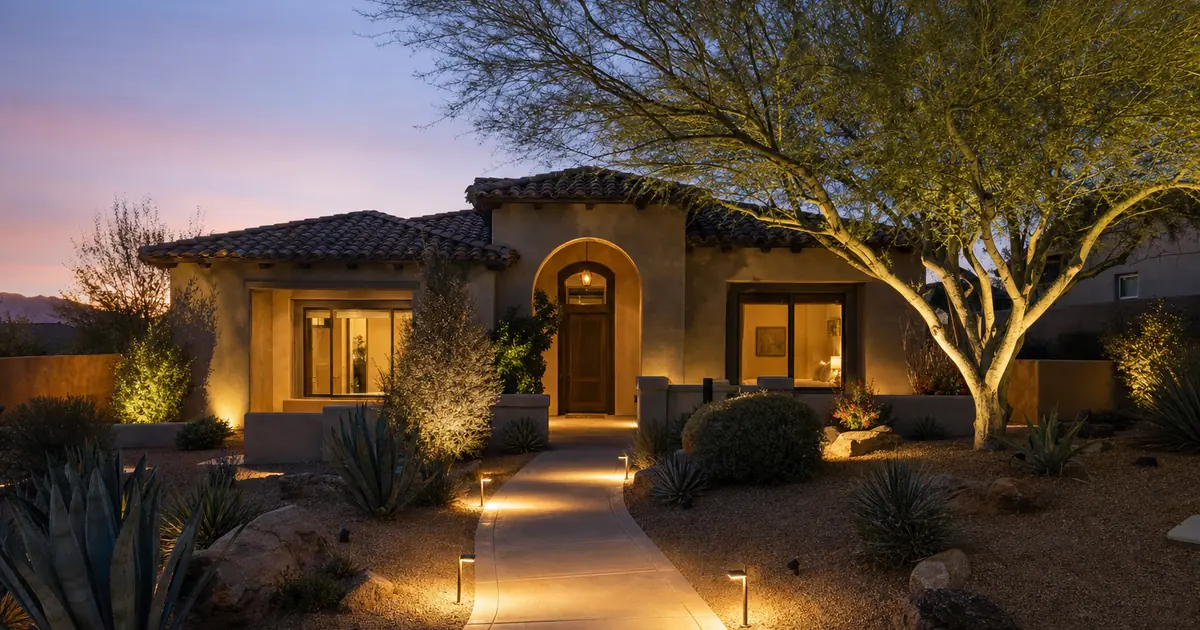
Landscape lighting in Mesa usually means a low-voltage system that lights paths, steps, trees and entries, and much of the real work happens underground. Every fixture is fed by cable buried in a yard that can also hold irrigation lines, City of Mesa gas or electric lines, or SRP equipment. That is why this page starts with how the system works, then covers the City of Mesa permit question, the digging rules, where the light should and should not go, and how a system is switched and maintained.
It is written for single-family homes in the City of Mesa and covers low voltage lighting, pathway lighting and the 120-volt source that feeds them. Wall lights and security floodlights mounted on the house itself are covered on a separate page.
Key takeaways
- The City of Mesa tells residents to contact Arizona 811 two days before digging for any reason, and SRP says every digging job, even planting trees and shrubs, requires that call.
- Mesa says to hand-dig within two feet of marked facilities and to keep locate marks visible and valid, which it puts at 15 days, for the duration of the project.
- The City of Mesa lists installing or modifying electrical systems as work that needs a permit, which covers a new outdoor outlet or circuit for a lighting power supply.
- Mesa Zoning Ordinance section 11-30-5 on lighting and illumination applies to all projects except single residence dwellings and middle housing.
- A 2023 Electrical Contractor magazine summary of National Electrical Code Article 411 says outdoor low-voltage lighting where wet contact is likely operates at no more than 15 volts AC or 30 volts DC.
- Mesa Police advise a window of visibility, trimming trees up to 7 feet and shrubs down to 3 feet, because trees planted beside lights can block them as they mature.
What does a landscape lighting installation in Mesa involve?
A landscape lighting installation puts light on the parts of a property people use or look at after dark: walkways, steps, driveways, trees, walls, gates and the front entry. Two kinds of system do this. A low-voltage system uses a power supply, often called a transformer, that takes 120-volt power from the house, steps it down, and sends it through cable to each fixture. A line-voltage system runs ordinary 120-volt circuits to the fixtures themselves, which is how wall lights at doors and garages are normally wired.
Residential landscape and pathway lighting is usually low voltage, and the job has five parts that a good estimate describes one by one:
- The 120-volt source. An existing outdoor outlet, or a new outlet or circuit installed to feed the power supply.
- The power supply. Sized for the fixtures it feeds, mounted where it can be reached, and kept out of standing water and irrigation spray.
- The cable. Run from the power supply to each fixture, buried, and laid out so no run is overloaded or too long for the fixtures at its far end.
- The fixtures. Path lights, uplights for trees and palms, wall washers, step lights and well lights set into the ground.
- The controls. A timer, a photocell that switches at dusk, or both.
The design decisions come first: what you want to see from the street, from the patio and from inside the house, and what you do not want lit at all. The cable route follows the design and the underground conditions, not the other way around. Pathway lighting is a frequent starting point because it solves a practical problem, safe footing at night, and it can be extended later to trees and walls from the same power supply if the supply and cable were sized with that in mind. For fixtures mounted on the house walls and eaves, see outdoor and security lighting in Mesa.
How does low voltage lighting work, and what electrical code applies in Mesa?
Mesa adopts the 2023 National Electrical Code with City amendments, and Article 80.1 of the City's amendment document says these regulations shall be known as the Mesa Electrical Code. Mesa Ordinance No. 5979, which the City Council passed and adopted on December 8, 2025, makes the current technical codes govern permit applications accepted on or after January 8, 2026.
Low-voltage lighting has its own article in the national code, Article 411. A 2023 summary in Electrical Contractor magazine explains that outdoors, where wet contact is likely, the operating voltage of these systems and their components does not exceed 15 volts AC or 30 volts DC. The same article says the system is built from listed parts, with a power supply identified for low-voltage lighting and cable suitable for direct burial. In plain terms, the fixtures, the cable and the power supply are meant to be made and used as a system for this purpose, not pieced together from indoor parts and extension cords.
Mesa's amendments change a short list of national code sections, including receptacle, service-disconnect, grounding and EV-charger rules. Our reading of that list is that it does not amend Article 411 or section 210.8, the section that sets where ground-fault circuit-interrupter (GFCI) protection is required, so both apply in Mesa as published. A GFCI trips when it senses ground-fault current, meaning current leaking to ground, which outdoors is often caused by moisture. That matters on the 120-volt side of a lighting system: the outlet that feeds the power supply sits outdoors, and the protection on it is part of the job, not an accessory.
Low voltage lowers the shock risk on the cable side. It does not make a system trouble-free. When we are called to a low-voltage system that has stopped working, the fault is usually at a buried connection or splice, or at the outlet feeding the power supply, rather than in a fixture. Connections made to stay dry, and a properly protected feed, are where a careful installation spends its time.
Does landscape lighting in Mesa need a City permit?
It depends on what is being installed, and the City's own pages answer only part of the question. The City of Mesa's residential construction page lists "Installing or modifying electrical, plumbing, or mechanical systems" among the work that needs a construction permit. A new outdoor circuit, or a new outlet to feed a lighting power supply, modifies the home's electrical system. The City's residential construction FAQ adds that "Any structure with electrical, plumbing, or mechanical connections require a construction permit," which matters when lighting is part of a new ramada, shade structure or shed.
What we could not find is a City of Mesa document that says whether a low-voltage system plugged into an existing outdoor outlet needs a permit. Rather than guess, treat that as a question for City of Mesa Permit Services, at 480-644-4273 or PermitServices@MesaAz.gov, before work starts. The table below sets out what the City documents do and do not say for the usual landscape-lighting jobs.
| Job | What the source says | Document | What it means for the job (our reading) |
|---|---|---|---|
| Plug-in low-voltage system on an existing outdoor outlet | Not given | None found | Ask Permit Services before work starts; do not assume either way |
| New outdoor outlet or circuit to feed a power supply | Installing or modifying electrical systems needs a permit | City of Mesa, Residential Construction | Permit work under the Mesa Electrical Code |
| Line-voltage fixtures on new 120-volt circuits | Same permit rule | City of Mesa, Residential Construction | Permit work |
| Lighting on a new ramada, shed or shade structure | Any structure with electrical connections requires a construction permit | City of Mesa, Residential Construction FAQ | Plan the lighting into the structure's permit |
| Trenching cable anywhere in the yard | Contact Arizona 811 two days before digging for any reason | City of Mesa, Energy Safety & Education | Applies whether or not a permit is needed |
| Aiming and shielding fixtures at a single home | The lighting section applies to all projects except single residence dwellings and middle housing | Mesa Zoning Ordinance 11-30-5 | No Mesa zoning limit found for one home; Arizona's shielding statute and good design still guide it |
How we got this table. The middle columns summarize City of Mesa web pages and the Mesa zoning ordinance text (read through a third-party mirror of Title 11 that lists amendments through March 9, 2026), all read on November 26, 2026. The right-hand column is our own reading, not a City interpretation; Permit Services and the inspector decide. No City document we found addresses plug-in low-voltage systems, so that cell says Not given.
What do you have to do before digging for pathway lighting in Mesa?
Request an Arizona 811 locate first. The City of Mesa says: "Contact Arizona 811 two days before you plan to dig for any reason to have underground utilities located and marked." SRP makes the same point from its side, saying that "every digging job requires contacting Arizona 811," and it includes planting trees and shrubs. A trench for lighting cable is a digging job, however shallow it looks.
Arizona law sets the timing. Under A.R.S. 40-360.22, an underground facilities operator "shall respond as promptly as practicable, but not later than two working days." The same section says the white-lining step, where the dig area is pre-marked, does not apply to a person digging on single-family residential property they own or occupy; the locate request itself still applies.
Once the marks are down, Mesa's page sets two rules for the rest of the job. It says to "Keep all locate marks visible and valid (15 days) for the duration of your project," and to "Hand-dig within two feet of marked facilities, supporting and protecting exposed facilities." A lighting trench often runs alongside a walk or driveway, which can put long stretches of it inside the hand-dig zone of a marked service line. That changes how long the trench takes, so it belongs in the plan before the fixture layout is final.
| Rule | Number | Source | What it means for a lighting trench (our arithmetic or reading) |
|---|---|---|---|
| Notice before digging | 2 days (City); operator response within 2 working days (statute) | City of Mesa; A.R.S. 40-360.22 | Request the locate before the installation date is set, not on the day (our reading) |
| Hand-dig zone near a mark | 24 inches (2 feet) | City of Mesa | Hand tools only across a band at least 4 feet wide plus the width of the marked line (our arithmetic: 2 feet on each side) |
| Locate marks valid | 15 days (City); fifteen working days (statute, 40-360.22(J)) | City of Mesa; A.R.S. 40-360.22 | A job that runs longer than the marks are valid needs them kept current (our reading) |
| Planting setback, sides and rear of SRP underground and pad-mounted equipment | 3 feet | SRP blog, May 14, 2024 | Keep new plants, fixtures and trenches clear of the sides and back of the equipment (our reading) |
| Planting setback, front of SRP underground and pad-mounted equipment | 12 feet | SRP blog, May 14, 2024 | Leave the front open; do not hide the equipment behind a lit planting bed (our reading) |
How we got this table. The numbers come from the City of Mesa Energy Safety and Education page (undated), Arizona Revised Statutes section 40-360.22 and an SRP blog post dated May 14, 2024, all read on November 26, 2026. The City gives 15 days for locate marks while the statute words its limit as fifteen working days, so both are shown. SRP's setbacks are written for plantings; applying them to fixtures and trenches is our reading. The 4-foot band is our arithmetic. No burial depth is shown because no source we read sets one for low-voltage cable.
Which utility lines can be under a Mesa yard, and what will Arizona 811 not mark?
Two electric utilities serve Mesa homes. The City of Mesa says "Salt River Project (SRP) supplies electric service to about 90% of Mesa residents," and the remaining homes are served by City of Mesa Electric, the City's own utility in the area around downtown. Either can have underground service lines in a residential yard, and SRP's pad-mounted equipment sits on or near some lots. Which utility serves your address also decides who you call about an outage or a damaged line; the differences are set out on City of Mesa Electric and SRP explained.
The bigger surprise for many homeowners is what is not marked. The City of Mesa's safety page explains that utilities locate what they own and that marks typically stop at the meter, so customer-owned buried piping beyond the meter is not marked. The City makes that point about gas piping and lists 480-644-4552 for questions about customer-owned buried piping, and the same logic holds for any line a homeowner owns. A feed to a detached garage or casita, irrigation lines and valves, an older lighting cable, or a circuit to a pool pump or yard outlet will not show up in an Arizona 811 locate.
On Mesa yards we often find old lighting cable and irrigation lines sharing the same shallow ground along walks and planters, with nothing on the surface to show where they run. Before we set a trench line, we ask the homeowner what was added after the house was built, and we probe and hand-dig wherever an owner line is likely.
If a trench damages a utility line, stop work and keep everyone back. For electric lines, the City of Mesa's downed power line guidance says to "Assume all downed wires are energized and dangerous even if there is no spark," to stay at least 20 feet away, and to call 9-1-1 or 480-644-2262.
Does Mesa limit how bright residential landscape lighting can be or where it shines?
Not through its zoning code, as far as we could find. Mesa Zoning Ordinance section 11-30-5, Lighting and Illumination, states: "The requirements of this Section shall apply to all projects except Single Residence Dwellings and Middle Housing." Where the section does apply, on other kinds of projects, it says "Such lighting should be controlled to minimize adverse impacts to abutting residential uses," and it caps detached light fixtures in residential districts at 15 feet. That is a useful signal of what the City cares about, even though a single home is exempt. We could not open the other outdoor-lighting provisions of the Mesa City Code, so this page makes no claim about them.
Arizona also has a shielding statute. A.R.S. 49-1102 says "All outdoor light fixtures shall be fully or partially shielded except incandescent fixtures" of 150 watts or less and other sources of 70 watts or less. We did not confirm how that statute is applied inside Mesa, so treat it as Arizona's stated standard rather than a City rule. Shielding is good design for any fixture, whatever its wattage.
DarkSky International's lighting principles give a simple test for each fixture: light should be useful, targeted, low level, controlled and warm-colored. In its words, "Direct light so it falls only where it is needed," and "Light should be no brighter than necessary." For a Mesa yard, that means path lights that put light on the path rather than in people's eyes, uplights aimed into a canopy rather than at a neighbor's window, and no fixture that shows a bare lamp from the street.
How should landscape lights be placed around desert trees, shrubs and utility equipment in Mesa?
Plan for the plants at full size. Mesa Police crime-prevention guidance on landscaping and lighting warns that "Trees are often planted next to light poles and at maturity, the tree blocks the light," and advises a "3'-7' window of visibility – trim trees up to 7' and shrubs down to 3'". The same guidance says to "Consider plant size at maturity." The point applies to landscape fixtures as well as poles: a path light set beside a young shrub can disappear into foliage a few seasons later, and an uplight placed tight against a trunk lights bark instead of the canopy.
Security and appearance pull in the same direction. Light on entries, side yards and the walk to the door helps people see who is there, and keeping shrubs low and canopies raised lets that light reach the ground. We set path lights beside the walk rather than in it, and we leave room around each fixture for the plant next to it to grow.
Utility equipment needs its own space. SRP advises keeping plantings 3 feet from the sides and rear and 12 feet from the front of its underground and pad-mounted equipment. Those distances are written for plants, and the same thinking suits fixtures and cable: keep the front of the equipment open, do not trench alongside it, and do not hide it behind a lit planting bed.
How should landscape lighting be switched and maintained in Mesa?
Controls decide how useful a system is and how long it runs. A timer turns lights on and off at set times; a photocell switches them on at dusk; a common setup uses a photocell to turn the system on and a timer to turn it off later in the evening. Mesa Police advise residents to "Adjust on/off times seasonally as needed" and to replace burned-out bulbs promptly, because a dark fixture on a walk is a gap in the lighting.
Maintenance is mostly about the yard changing around the system:
- Re-aim fixtures after plants grow, after pruning and after any yard work that bumps them.
- Check that path lights still stand upright and that their lenses are clear of dust and debris.
- Look for cable exposed by erosion, irrigation repairs or new planting holes, and rebury it.
- Reset timers after a power outage if the controller does not keep time on its own.
- Press the test button on the GFCI that protects the outdoor outlet feeding the power supply.
When part of a system goes dark and the rest stays lit, the problem is usually on that run: a cut cable, a failed connection or a fixture that took on water. When the whole system goes dark, start at the outlet and its GFCI. If the outlet keeps tripping, that is a wiring problem rather than a lighting problem; see electrical repair and troubleshooting in Mesa or outlet installation and repair in Mesa.
What are the most common mistakes with landscape lighting in Mesa?
- Digging before the locate. The City of Mesa says to contact Arizona 811 two days before digging for any reason, and SRP counts planting as digging.
- Assuming 811 marked everything. Utility marks typically stop at the meter; lines the homeowner owns are not marked.
- Using a shovel inside the hand-dig zone. Mesa says to hand-dig within two feet of marked facilities.
- Lighting the neighbor's house. Mesa's zoning lighting section does not cover single homes, but unshielded uplights and floods aimed outward still throw light where nobody needs it.
- Placing fixtures for today's plants. Mesa Police advise considering plant size at maturity.
- Feeding the system from an unprotected outlet. The 120-volt side needs proper GFCI protection, and a new outlet or circuit is permit work in Mesa.
For indoor fixtures and lighting on the house itself, see lighting installation in Mesa.
Who installs landscape lighting in Mesa?
Arizona licenses contractors through the Registrar of Contractors. The City of Mesa's residential construction page says owner-occupied projects may not require a licensed contractor and refers homeowners to the Registrar's guidelines, so a homeowner can do some of this work. The locate request, the hand-dig rule and the permit rule for new electrical work apply either way.
Before hiring anyone for a lighting job, ask for the license number and classification; who will request the Arizona 811 locate and keep the marks valid; whether the job needs a new outlet or circuit, and who will take out the City of Mesa permit; and how the cable route avoids both marked lines and owner-owned lines. Ask for the fixture layout and the controls in writing, so two estimates describe the same system.
Landscape lighting requested through Your Mesa Electrician is performed by Alvey Electric LLC, Arizona Registrar of Contractors license ROC 364723 (R-11, residential). The work is residential only.
Frequently asked questions
Does landscape lighting in Mesa need a City permit?
It depends on the work. The City of Mesa lists installing or modifying electrical systems as work that needs a construction permit, so a new outdoor outlet or circuit to feed a lighting power supply is permit work. No City document we found says whether a plug-in low-voltage system on an existing outlet needs one, so ask City of Mesa Permit Services at 480-644-4273 before you start.
How much does landscape lighting cost in Mesa?
This page does not quote a price because no public source sets one. The cost depends on the number and type of fixtures, the length of cable, how much of the trench has to be dug by hand near marked utility lines, the size of the power supply and controls, and whether a new outdoor outlet or circuit and a City of Mesa permit are needed. A written estimate after a site visit and a layout is the reliable number.
What do you have to do before digging for pathway lighting in Mesa?
Request an Arizona 811 locate. The City of Mesa tells residents to contact Arizona 811 two days before digging for any reason so underground utilities can be located and marked, and SRP says every digging job requires that call, including planting trees and shrubs. Under Arizona law, operators must respond no later than two working days after the request.
How close can I dig to a marked utility line in Mesa?
Use hand tools only within two feet of a marked facility. The City of Mesa says to hand-dig within two feet of marked facilities and to support and protect anything you expose. Mesa also says to keep locate marks visible and valid, which it puts at 15 days, for the whole project, so a long job needs its marks kept current.
What voltage is low-voltage landscape lighting?
Outdoors, where wet contact is likely, low-voltage lighting operates at no more than 15 volts AC or 30 volts DC, according to a 2023 Electrical Contractor magazine summary of National Electrical Code Article 411. The power supply that steps household 120-volt power down must be identified for low-voltage lighting, the parts must be listed, and the cable must be suitable for direct burial. By our reading, Mesa's code amendments do not change Article 411.
Does Mesa have dark-sky rules for home landscape lighting?
We found none for single homes. Mesa's zoning section on lighting and illumination applies to all projects except single residence dwellings and middle housing. Arizona's statute A.R.S. 49-1102 requires outdoor fixtures to be fully or partially shielded, with exceptions for lower-wattage lamps, though we did not confirm how it applies inside Mesa. Aiming light down and keeping it on your own property is still the sound approach.
Can I plug landscape lighting into an existing outdoor outlet?
Many low-voltage power supplies are made to plug into an outdoor outlet, and that outlet then becomes part of the lighting system. It needs ground-fault (GFCI) protection where the National Electrical Code requires it. No City of Mesa document we found addresses whether a plug-in system needs a permit; a new outlet or circuit does, because the City lists modifying electrical systems as permit work.
Will Arizona 811 mark the electric and irrigation lines I own?
No. Utilities locate what they own, and the City of Mesa explains that marks typically stop at the meter, so customer-owned buried lines beyond it are not marked. That can include a feed to a detached garage or casita, irrigation lines, an older lighting cable or a pool circuit. Find those from records, from whoever installed them, or by careful hand digging before a trench is cut.
When should landscape lights turn on and off in Mesa?
A common setup uses a photocell to turn lights on at dusk and a timer to turn them off later in the evening. Mesa Police advise adjusting on and off times seasonally as needed and replacing burned-out bulbs promptly. Running lights only when they are useful also follows DarkSky International's principle that light should be controlled.
What should I do if I hit a utility line while digging in Mesa?
Stop digging and keep everyone away from the line. For electric lines, the City of Mesa says to assume all downed wires are energized and dangerous even if there is no spark, to stay at least 20 feet away, and to call 9-1-1 or 480-644-2262. If there is fire, call 9-1-1. Do not try to repair, move or rebury the damaged line yourself.
Who installs landscape lighting requested through Your Mesa Electrician?
Landscape lighting requested through Your Mesa Electrician is performed by Alvey Electric LLC, Arizona Registrar of Contractors license ROC 364723 (R-11, residential), a residential electrical contractor. The work is residential only. When you request an estimate, ask about the fixture layout, the Arizona 811 locate and whether the job needs a City of Mesa permit.
The short version
Treat a landscape lighting job in Mesa as a digging job first and a lighting job second: get the Arizona 811 locate, find the lines you own, and route cable around both. Lay out fixtures for the plants at full size and aim each one at something you actually want to see. If the job adds an outdoor outlet or circuit, it is permit work in Mesa; if it only plugs in, ask Permit Services rather than assume.
This page is general information about residential electrical work in Mesa, Arizona. It is not engineering, legal or code advice for a specific property. Permit rules, utility requirements and adopted codes change; confirm current requirements with the City of Mesa and your electric utility before work begins.
References
- City of Mesa, Energy Safety & Education (Arizona 811, locate marks, hand-digging, customer-owned piping), undated, read November 26, 2026 https://www.mesaaz.gov/residents/energy/safety-education. Read November 26, 2026.
- City of Mesa, Downed Power Lines, undated, read November 26, 2026 https://www.mesaaz.gov/Utilities/Energy/Energy-Safety-Education/Downed-Power-Lines. Read November 26, 2026.
- City of Mesa, Savings & Rebates (SRP serves about 90% of Mesa residents), undated, read November 26, 2026 https://www.mesaaz.gov/Utilities/Savings-Rebates. Read November 26, 2026.
- Mesa Zoning Ordinance section 11-30-5, Lighting and Illumination (Zoneomics mirror of Mesa Title 11, amendments listed through March 9, 2026), read November 26, 2026 https://www.zoneomics.com/code/mesa-AZ/chapter_4. Read November 26, 2026.
- Mesa Police Department Crime Prevention, Crime Prevention Considerations: Landscaping and Lighting, undated, read November 26, 2026 https://www.mesaaz.gov/files/assets/public/v/1/publicsafety/police/publications/landscapinglighting.pdf. Read November 26, 2026.
- City of Mesa Development Services, Residential Construction (permit list, Permit Services contact, owner-occupied projects), read November 26, 2026 https://www.mesaaz.gov/business/development-services/residential-construction. Read November 26, 2026.
- City of Mesa, Residential Construction FAQ, undated, read November 26, 2026 https://www.mesaaz.gov/Business-Development/Development-Services/Building-Permit-Plan-Review/Residential-Construction/Residential-Construction-FAQ. Read November 26, 2026.
- City of Mesa Ordinance No. 5979, adopted December 8, 2025 (codes for permit applications on or after January 8, 2026), read November 26, 2026 https://mcclibraryfunctions.azurewebsites.us/api/ordinanceDownload/15749/1399976/pdf. Read November 26, 2026.
- City of Mesa, Amendments to the 2023 National Electrical Code (Mesa Electrical Code), read November 26, 2026 https://www.mesaaz.gov/files/assets/public/v/3/business-development/devsvcs/codeamendments/2023-nec-amendment.pdf. Read November 26, 2026.
- SRP blog, Don't risk digging into live wires, May 14, 2024, read November 26, 2026 https://blog.srpnet.com/call-811-before-you-dig/. Read November 26, 2026.
- Arizona Revised Statutes 40-360.22, Excavation requirements, read November 26, 2026 https://www.azleg.gov/ars/40/00360-22.htm. Read November 26, 2026.
- Arizona Revised Statutes 49-1102, Outdoor light control (shielding), read November 26, 2026 https://www.azleg.gov/ars/49/01102.htm. Read November 26, 2026.
- DarkSky International, Lighting Principles (April 2020, graphic updated September 2023), read November 26, 2026 https://darksky.org/resources/guides-and-how-tos/lighting-principles/. Read November 26, 2026.
- Electrical Contractor magazine, Mark C. Ode, Creating the Right Look: Low-voltage landscape lighting for homes, June 15, 2023, read November 26, 2026 https://www.ecmag.com/magazine/articles/article-detail/creating-the-right-look-low-voltage-landscape-lighting-for-homes. Read November 26, 2026.
Plan your landscape lighting
Request a fixture layout and a written estimate for low-voltage lighting at your Mesa home.
Related pages
About this page
Written by the Your Mesa Electrician editorial team from the sources listed above. Reviewed by Robert "Bob" Lira, licensed Arizona electrical contractor, ROC 338369. Your Mesa Electrician, 1740 S Robin Ln, Mesa, AZ 85204, phone 480-701-4348, serves homes in the City of Mesa. Electrical work is performed by Alvey Electric LLC, Arizona Registrar of Contractors license ROC 364723 (residential electrical).
Updated .