Residential electrical service - Mesa, Arizona
Ceiling Fan Installation Mesa AZ: Boxes, Permits and Attic Fans (2026 Guide)
How a ceiling fan should be mounted and wired, when the City of Mesa permit rules apply, what City of Mesa Electric and SRP say about summer settings, and what federal research says about attic fans.
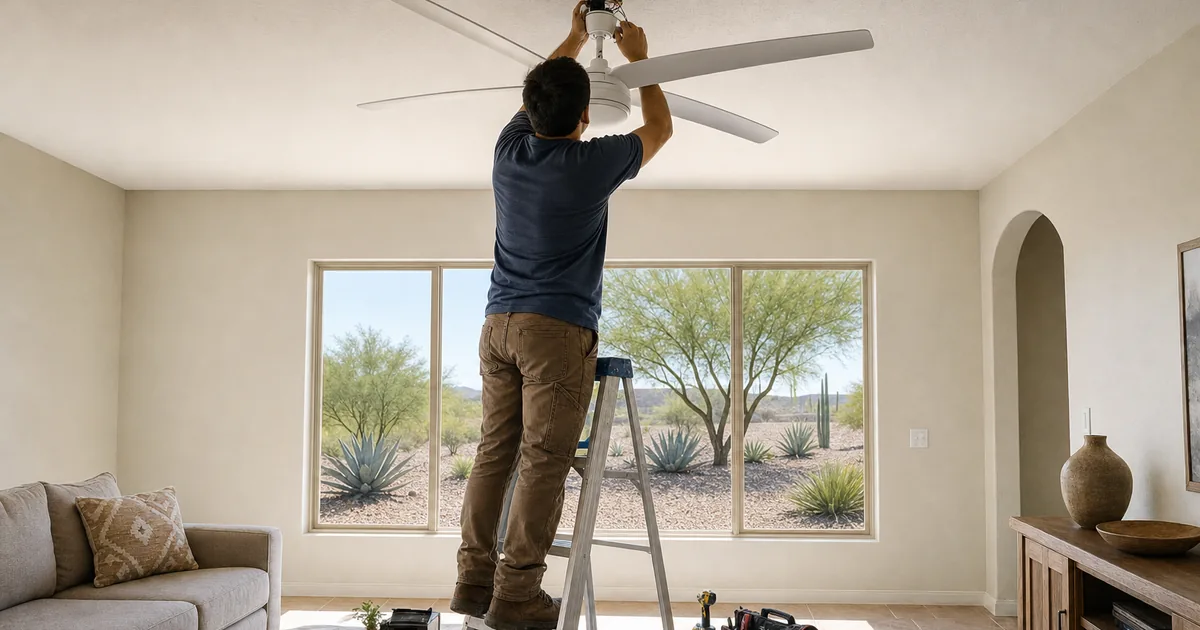
Quick answer
Ceiling fan installation in Mesa means mounting the fan on a box listed for fan support, wiring and switching it correctly, and setting it to spin counterclockwise in summer. The City of Mesa and the U.S. Department of Energy both say a fan used with the air conditioner lets you raise the thermostat about 4°F. The City lists modifying electrical systems and adding circuits as permit work. For attic fans, federal building research finds they often cause more energy loss than they save.
Ceiling fan installation in Mesa is a small electrical job with two questions behind it that matter more than the fan you choose: will the box in the ceiling safely hold a heavy, spinning load, and will the fan actually let you run the air conditioner less? This guide answers both from City of Mesa, SRP and U.S. Department of Energy sources. It also covers attic fan installation in Mesa, AZ, where federal building research gives a more cautious answer than most product packaging does.
It is written for single-family homeowners in the City of Mesa who are replacing a light with a fan, adding a fan to a bedroom or covered patio, or weighing a powered attic fan. It does not quote prices, because no public source sets one; instead it explains what decides the scope of the job, which is what decides the estimate.
Key takeaways
- The City of Mesa and the U.S. Department of Energy both say a ceiling fan used with the air conditioner lets you raise the thermostat about 4°F.
- SRP recommends 78° to 80° at home and up to 85° when away, and says each degree above 80° saves approximately 2% to 3% on cooling costs.
- Mesa's single-family plan-review checklist calls for approved outlet boxes for ceiling fans, and a fan should hang from a box listed for fan support.
- The City of Mesa lists installing or modifying electrical systems as permit work, and its residential FAQ says new circuits require a permit.
- The U.S. Department of Energy says a 36- or 44-inch fan suits rooms up to 225 square feet, hung 7 to 9 feet up with blades at least 8 inches from the ceiling and 18 inches from walls.
- Pacific Northwest National Laboratory's Building America guidance says attic ventilation fans often cause more energy loss than they save and recommends passive attic ventilation instead.
What does ceiling fan installation in Mesa involve?
A ceiling fan is a heavier, moving relative of a light fixture. It usually weighs more than a fixture, it turns for hours at a time, and any imbalance in the blades becomes vibration at the point where it is mounted. That is why a proper installation is mostly about what sits above the ceiling, not what hangs below it. A complete job covers four things: a box that is listed for fan support and fastened to the framing, wiring and switching that suit how the fan and its light will be controlled, a mounting height and blade clearance that work for the room, and a fan that is assembled, balanced and set to the right direction for the season.
Most requests fall into one of three jobs, and the difference matters for the paperwork and the time involved.
- Replacing a light with a fan. The wiring is already in place, but the existing box may have been installed only to carry a light fixture. Confirming or replacing the box is the main task.
- Adding a fan where there is no ceiling box. New cable is run from a suitable circuit to a new fan-rated box, and new switching is often added so the fan and its light can be controlled separately.
- Adding a fan on a new circuit. A covered patio, a garage or a detached room may need a circuit of its own. The City of Mesa says new circuits require a permit.
If the project is really about light rather than air, our page on lighting installation in Mesa covers fixtures, recessed lights and switching.
What happens during a ceiling fan installation?
The circuit is switched off at the breaker and confirmed dead before anything is opened. The existing box is checked for a fan-support marking and for how it is attached to the framing; if it is not suitable, it is replaced with a fan-rated box or a brace that spans the framing. The mounting bracket goes onto the box, the downrod or close-mount hardware is assembled, and the conductors are connected according to the manufacturer's instructions, including the equipment grounding conductor. The blades go on last. The fan is then run at each speed to check for wobble and noise, and the direction switch is set for the season. On Mesa jobs we often find that the homeowner has already bought the fan before anyone has looked at the box; the fan rarely has to change, but sometimes the box does.
Does a ceiling fan really let you use less air conditioning in Mesa?
Yes, if it is used the way the City of Mesa and the federal government describe. The City of Mesa's energy saving tips say that "using your ceiling fan while your air conditioner is on will allow you to raise your thermostat about 4°F." The U.S. Department of Energy gives the same figure, saying a fan lets you "raise the thermostat setting about 4°F with no reduction in comfort." The saving comes from the higher thermostat setting, not from the fan itself. A fan that runs while the thermostat stays exactly where it was adds a little electricity use and saves nothing.
Two habits decide whether the fan earns its place. The first is direction. The City advises homeowners to "adjust your ceiling fans to run counter clockwise to push cool air down," and says that "During the winter ceiling fans should run at a low speed in a clockwise direction." The Department of Energy also recommends counterclockwise rotation in summer. The second habit is switching off. The City says, "Remember to shut off ceiling fans when you leave the room," and the Department of Energy says to "be certain to turn off ceiling fans when you leave a room." Our reading of that advice is simple: a fan helps the people it blows on, so a fan turning in an empty bedroom all afternoon gives nobody any benefit.
The efficiency of the fan you buy matters too. ENERGY STAR says certified ceiling fans "Are up to 44% more efficient than conventional fans." That is a product-level figure from ENERGY STAR, not a measurement of any Mesa home. Our research did not turn up a ceiling fan rebate from either the City of Mesa or SRP, so this page does not suggest that one exists.
What summer thermostat settings do City of Mesa Electric and SRP recommend?
Mesa homes buy electricity from one of two utilities. According to the City of Mesa's savings and rebates page, "Salt River Project (SRP) supplies electric service to about 90% of Mesa residents," and the rest of the city is served by the City's own utility, City of Mesa Electric. The name on your bill tells you which one is yours, and our guide to City of Mesa Electric and SRP explains how the two differ.
Both publish summer thermostat advice, and their numbers line up with what a ceiling fan makes comfortable. The City of Mesa says, "During summer peak hours or when you're not home, remember to set your thermostat at 78° or higher," and that "Setting your air conditioner 5° higher can save up to 20 percent on cooling costs." SRP says, "We recommend setting your thermostat to 78°–80° while at home and up to 85° when away to maximize energy savings," and adds that "For every degree you set your thermostat above 80°, you can save approximately 2% to 3% on cooling costs."
SRP customers on a time-of-use plan have one more reason to care. On its Conserve 6-9 p.m. and Save plan, SRP tells customers to "Limit your power use from 6-9 p.m. and use lower-cost power during super off-peak hours between 8 a.m. and 3 p.m." Its Manage Demand 5-10 p.m. and Save plan uses a 5 to 10 p.m. window instead. SRP's tips page does not mention ceiling fans; the fan advice on this page comes from the City of Mesa and the Department of Energy. Putting the two together is our reading: a fan that lets a household hold a higher setting through the evening on-peak hours is one of the simpler ways to follow SRP's advice without the house feeling hotter.
| What the source says | Number | Source |
|---|---|---|
| Thermostat raise allowed by a ceiling fan used with the air conditioner | About 4°F | City of Mesa Energy Saving Tips; U.S. DOE Fans for Cooling |
| City of Mesa setting during summer peak hours or when away | 78° or higher | City of Mesa Energy Saving Tips |
| SRP recommended setting while at home | 78° to 80° | SRP Everyday energy-saving tips |
| SRP recommended setting while away | Up to 85° | SRP Everyday energy-saving tips |
| SRP saving for each degree above 80° | About 2% to 3% of cooling costs | SRP Everyday energy-saving tips |
| City of Mesa saving for a setting 5° higher | Up to 20% of cooling costs | City of Mesa Energy Saving Tips |
| SRP estimate for attic insulation and air sealing | Roughly 10% lower cooling costs | SRP Everyday energy-saving tips |
How we got this table. The numbers are copied from the City of Mesa Energy Saving Tips page, SRP's Everyday energy-saving tips page and the U.S. Department of Energy's Fans for Cooling page, all undated and read on November 26, 2026. The percentages are each source's own estimates for cooling costs, not measured results for any Mesa home, and the City's and SRP's percentages describe different steps, so they should not be added together. SRP's page does not mention ceiling fans.
Why does a ceiling fan in Mesa need a box listed for fan support?
An ordinary ceiling box is made to carry a light fixture that hangs still. A fan adds weight and constant motion, and the National Electrical Code treats the box at a fan outlet as a separate case. Mesa adopts the 2023 National Electrical Code with City amendments, known as the Mesa Electrical Code, and the City's current codes apply to permit applications submitted on or after January 8, 2026, under Ordinance No. 5979, which the City Council adopted on December 8, 2025. Mesa's amendment document changes a specific list of sections; the section on boxes at fan outlets (314.27) and the section on ceiling fans (422.18) are not among the sections Mesa amended, so they apply as the national code publishes them.
We did not open the 2023 text of that section for this page, so treat the details here as general guidance. A 2018 EC&M code column by Mike Holt, written about the 2017 edition of the NEC, summarizes the rule this way: a box used as the sole support of a ceiling-suspended fan must be listed and marked as suitable for that purpose; such a box may not support a fan heavier than 70 pounds; a fan over 35 pounds needs a box marked with the weight it can carry; and where a ceiling box sits at a location suitable for a fan and has spare, separately switched conductors, the box must be listed for fan support. The practical rule for a homeowner is short: the fan hangs from a box made and marked for fans, and that box is fastened to the building's framing.
Mesa's own plan-review checklist for single-family homes makes the same point for new work. That checklist, an older City document that cites the 2018 Mesa Residential Code, includes the line "Provide approved outlet boxes for ceiling fans. E4203.4". It applies to plans for new homes and additions, but the reasoning carries over to any fan: the box is reviewed because it is the part that fails if it is wrong.
On Mesa jobs we often find a light box in exactly the spot where a fan is wanted, held up by a light-duty bracket rather than secured to framing. Swapping it for a fan-rated box, or adding a brace between the framing members, is part of a correct installation, not an optional upgrade. A fan that wobbles after installation is usually telling you something about the mounting or the blade balance, and an existing fan that hums, wobbles or stops can be looked at under electrical repair and troubleshooting.
Do you need a City of Mesa permit to install a ceiling fan?
It depends on what the job changes, and the City's published documents do not answer every case. The City of Mesa's residential construction page lists "Installing or modifying electrical, plumbing, or mechanical systems" among work that needs a construction permit, and the City's residential construction FAQ says that "new electric meters or circuits will require a permit." Questions about a specific project go to City of Mesa Permit Services at 480-644-4273 or PermitServices@MesaAz.gov.
No City of Mesa document we read says whether replacing a light fixture with a ceiling fan on an existing box needs a permit, so this page does not claim either way. The table below lines up the common fan jobs against what the City documents do say, with our reading of each in the last column.
| Fan job | What the City document says | Which City document | Our reading |
|---|---|---|---|
| Replace a light fixture with a ceiling fan on the existing box | Not stated | No City document we read covers this job | Confirm the box is listed for fan support; ask Permit Services whether a permit applies |
| Add a fan at a new location, wired from an existing circuit | Installing or modifying electrical systems is listed as permit work | Residential Construction page | Expect a permit, because the electrical system is being modified |
| Add a fan on a new circuit (patio, garage, detached room) | New circuits require a permit | Residential Construction FAQ | Permit needed |
| Fans shown on plans for a new home or addition | Provide approved outlet boxes for ceiling fans (E4203.4) | Single Family Dwelling Requirements checklist (older; cites 2018 code) | Fan-rated boxes are part of plan review |
| Line-powered attic fan on a new circuit | New circuits require a permit; a switched light is required at attic HVAC equipment (E3903.4) | Residential Construction FAQ; Single Family Dwelling Requirements checklist | Permit needed for the circuit; keep attic lighting rules in mind when working near HVAC equipment |
| Solar-powered attic fan not connected to house wiring | Not stated | No City document we read covers this job | Ask Permit Services before work starts |
How we got this table. The middle columns come from three City of Mesa documents, the Residential Construction page, the Residential Construction FAQ and the Single Family Dwelling Requirements plan-review checklist, all undated and read on November 26, 2026. The checklist is an older document that cites the 2018 Mesa Residential Code. The right-hand column is our own reading, not a City interpretation; Permit Services decides. "Not stated" means no City document we read addresses that job.
The City's residential construction page also notes that owner-occupied projects may not require a licensed contractor, and it refers homeowners to the Arizona Registrar of Contractors guidelines. That speaks to who may do the work. The box and wiring rules apply either way.
What size ceiling fan fits a Mesa bedroom, living room or patio?
The U.S. Department of Energy's sizing guidance is the clearest public standard. It says "A 36- or 44-inch diameter fan will cool rooms up to 225 square feet," and recommends fans of 52 inches or more for larger rooms. For placement, DOE says the fan should hang 7 to 9 feet above the floor, with blades "no closer than 8 inches from the ceiling and 18 inches from the walls." The table turns those rules into room dimensions.
| DOE rule | What DOE says | What it means in a room (our arithmetic) |
|---|---|---|
| Fan size, smaller rooms | 36- or 44-inch fan for rooms up to 225 sq ft | 225 sq ft is a room about 15 by 15 feet |
| Fan size, larger rooms | 52 inches or more | A 16 by 16 foot room is 256 sq ft, already above the 225 sq ft line |
| Wall clearance, 44-inch fan | Blades at least 18 inches from walls | 22-inch blade reach plus 18 inches is 40 inches each side, so at least 80 inches (6 ft 8 in) wall to wall |
| Wall clearance, 52-inch fan | Blades at least 18 inches from walls | 26-inch blade reach plus 18 inches is 44 inches each side, so at least 88 inches (7 ft 4 in) wall to wall |
| Height on an 8-foot ceiling | Hang 7 to 9 feet up; blades at least 8 inches below the ceiling | A 7-foot blade height leaves 12 inches to the ceiling, so a close-mount fan is usually the fit |
How we got this table. The middle column is from the U.S. Department of Energy's Fans for Cooling page, undated, read on November 26, 2026. The right-hand column is our arithmetic from those rules, using half the fan diameter as the blade reach; it is not a DOE statement, and the fan maker's instructions govern the actual installation.
Ceiling shape changes the hardware more than the fan. A flat ceiling at a standard height often calls for a close-mount fan to keep the blades in DOE's range, while a tall or vaulted ceiling needs a downrod long enough to bring the blades down to 7 to 9 feet. A sloped ceiling needs mounting hardware that the fan's maker allows for a slope. For a covered patio, read the fan's instructions and markings for the location before buying; a fan that is not intended for that location is the wrong fan, however well it is mounted. On covered patios we look at how exposed the spot is and at the fan's own rating before we think about the box or the circuit.
Should you install an attic fan in a Mesa home?
People asking about attic fan installation in Mesa, AZ, are usually thinking of a powered ventilator on the roof or a gable that pulls hot air out of the attic. The idea sounds obvious, but federal building research is cautious about it. The Building America Solution Center, run by Pacific Northwest National Laboratory for the U.S. Department of Energy, says that "Studies also indicate that attic ventilation fans often cause more overall energy loss than they save," and that such fans can use more electricity than they save in air conditioning.
The reason is air pressure. PNNL explains that a powered attic fan depressurizes the attic, and that lower pressure can draw conditioned air from the house up through gaps in the ceiling, so the fan ends up exhausting air you have already paid to cool. Its recommendation is direct: "Passive attic ventilation is generally recommended over attic ventilation fans due to the multiple issues that can arise." If a homeowner still chooses a fan, PNNL's advice is to "Thoroughly air seal the ceiling to prevent the attic fan from pulling air out of the conditioned space." It also notes that "Solar-powered fans also tend to have lower CFM ratings, creating less negative pressure." Our reading is that a solar unit carries less of this risk, but it is not a substitute for sealing the ceiling first.
That points to an order of work. SRP says "Attic insulation and air sealing help reduce heat transfer and can lower cooling costs by roughly 10%." Sealing and insulating the ceiling comes first because it helps whether or not a fan is ever added. If a line-powered attic fan still makes sense after that, the circuit it needs is permit work under the City's FAQ, and Mesa's plan-review checklist reminds builders to "Provide a switched light at attic HVAC equipment. E3903.4", a useful rule to keep in mind whenever someone is working near equipment in the attic. When we are asked about an attic fan, we look at the ceiling from the attic side, at the openings around boxes and the access hatch, before we talk about the fan itself.
Are there ceiling fan or attic fan recalls Mesa homeowners should check?
Yes, two recent federal recalls touch this work directly. Both are national recalls announced by the U.S. Consumer Product Safety Commission; CPSC does not report how many of the products are in Mesa.
On August 28, 2025, CPSC announced a recall of about 2.9 million electric motors used in gable-mounted and roof-mounted attic fans, distributed by Air Vent and sold from August 2003 through December 2013. CPSC warns that "The recalled electric motor's safety cutoff may pose a risk of short circuit and fire hazard while in use," and it lists 159 reports of burning or fire. CPSC gives Air Vent's number as 877-247-4878 for owners checking their fans.
In 2026, CPSC announced a recall of about 9,460 Hampton Bay Halwin 52-inch indoor/outdoor ceiling fans manufactured by Youngo Limited. CPSC says "The fan blades can separate from the fan motor flywheel, posing impact and injury hazards to consumers," and it reports 11 incidents and no injuries. CPSC lists Youngo's contact number as 877-902-5588.
The practical step is the same for both: before an existing attic fan is kept in service, or before a fan you already own is reinstalled in a new room, check its make and model against the CPSC recall notice. A recalled product should not be rehung while the remedy is pending.
What are the most common mistakes with ceiling fan installation in Mesa?
- Hanging a fan from a light-only box. The box has to be listed for fan support and fastened to the framing; a box that held a light fixture may not qualify.
- Running the fan without raising the thermostat. The City of Mesa and DOE both tie the saving to a setting about 4°F higher. Without that change, the fan only adds load.
- Leaving fans on in empty rooms. The City and DOE both say to switch fans off when you leave the room.
- Forgetting the direction switch. The City advises counterclockwise in summer to push cool air down, and a low clockwise setting in winter.
- Choosing the wrong size or spot. DOE's sizing ties fan diameter to room area and calls for clearances of 8 inches from the ceiling and 18 inches from the walls.
- Adding a powered attic fan before sealing the ceiling. PNNL warns that attic fans can pull conditioned air out of the house and recommends air sealing first.
If a fan circuit keeps tripping its breaker after a new fan goes in, the cause should be diagnosed rather than reset over and over; our page on circuit breaker repair in Mesa explains how that is done.
Who is allowed to install a ceiling fan or attic fan in Mesa?
Arizona licenses contractors through the Registrar of Contractors. The City of Mesa's residential construction page says owner-occupied projects may not require a licensed contractor and refers homeowners to the Registrar's guidelines, so a homeowner doing work on their own home is not automatically required to hire one. The box rating, the wiring rules and any City permit apply whoever does the job.
Before hiring anyone, ask three things: the license number and classification, whether they will confirm the box is listed for fan support before the fan goes up, and who will handle any City of Mesa permit if new wiring or a new circuit is involved. A contractor who does this work regularly can answer all three on the first call. If you want the rest of the home's wiring checked at the same visit, see home electrical inspections in Mesa.
Ceiling fan and attic fan installations requested through Your Mesa Electrician are performed by Alvey Electric LLC, Arizona Registrar of Contractors license ROC 364723 (R-11, residential). The work is residential only.
Frequently asked questions
Do I need a permit to install a ceiling fan in Mesa?
It depends on the job. The City of Mesa lists installing or modifying electrical systems as permit work, and its residential FAQ says new circuits require a permit, so a fan at a new location or on a new circuit should be treated as permit work. No City document we read says whether swapping a light for a fan on an existing box needs a permit. Ask City of Mesa Permit Services at 480-644-4273 about your project.
How much does ceiling fan installation cost in Mesa?
This page does not quote a price because no public source sets one. The cost depends on whether the existing box is fan-rated or has to be replaced or braced, whether new cable or a new circuit is needed, how high and what shape the ceiling is, whether separate switching is added, and whether a City permit applies. A written estimate after someone has looked at the ceiling box is the reliable number.
Can I hang a ceiling fan from my existing light box?
Only if the box is listed and marked for fan support and fastened to the framing. A box installed for a light fixture may not be rated for the weight and motion of a fan. Mesa's plan-review checklist calls for approved outlet boxes for ceiling fans, and a summary of the national code by EC&M says boxes that solely support a fan must be listed for that purpose. If it is not marked, replace or brace it.
How much can a ceiling fan raise my thermostat setting in Mesa?
About 4°F. The City of Mesa says using a ceiling fan while the air conditioner runs lets you raise the thermostat about 4°F, and the U.S. Department of Energy gives the same figure with no reduction in comfort. The saving comes only from actually raising the setting. Both sources also say to switch the fan off when you leave the room.
Which way should a ceiling fan spin in a Mesa summer?
Counterclockwise. The City of Mesa advises running ceiling fans counterclockwise in summer to push cool air down, and the U.S. Department of Energy gives the same advice. In winter, the City says fans should run at a low speed in a clockwise direction. Most fans have a small direction switch on the motor housing, and it should be set with the fan stopped.
What size ceiling fan do I need for my room?
The U.S. Department of Energy says a 36- or 44-inch fan will cool rooms up to 225 square feet, and fans of 52 inches or more suit larger rooms. DOE also says to hang the fan 7 to 9 feet above the floor, with blades at least 8 inches from the ceiling and 18 inches from the walls. On an 8-foot ceiling, that usually points to a close-mount fan.
Should I install an attic fan in my Mesa home?
Federal research says to be cautious. Pacific Northwest National Laboratory's Building America guidance says attic ventilation fans often cause more energy loss than they save, because they can pull conditioned air from the house through ceiling gaps. It generally recommends passive attic ventilation instead and says to air seal the ceiling first if a fan is used. SRP says insulation and air sealing can lower cooling costs by roughly 10 percent.
Are solar attic fans better than electric attic fans?
They carry less of the main risk, but they do not remove it. Pacific Northwest National Laboratory says solar-powered attic fans tend to have lower airflow ratings, which creates less negative pressure in the attic. The same guidance still recommends air sealing the ceiling before any attic fan is used, and generally prefers passive ventilation. No City of Mesa document we read says whether a solar fan needs a permit.
How do I know if my ceiling fan or attic fan has been recalled?
Check the make and model against the U.S. Consumer Product Safety Commission recall notices. In August 2025 CPSC announced a recall of about 2.9 million attic fan motors distributed by Air Vent and sold from 2003 through 2013, citing a fire hazard. In 2026 it announced a recall of about 9,460 Hampton Bay Halwin 52-inch ceiling fans because the blades can separate. Do not rehang a recalled fan.
Does SRP or the City of Mesa offer a ceiling fan rebate?
Our research did not find one. Neither the City of Mesa's energy pages nor SRP's energy-saving tips page that we read lists a ceiling fan rebate, so this page does not claim one exists. Programs change, so check with your own utility. ENERGY STAR says certified ceiling fans are up to 44 percent more efficient than conventional fans, which is worth weighing when you choose a model.
Who installs ceiling fans requested through Your Mesa Electrician?
Ceiling fan and attic fan installations requested through Your Mesa Electrician are performed by Alvey Electric LLC, Arizona Registrar of Contractors license ROC 364723, classification R-11 Electrical, residential. The work is residential only. Before the fan goes up, the ceiling box is checked for a fan-support rating, and any City of Mesa permit question for new wiring or a new circuit is handled as part of the job.
The short version
Treat the box, not the fan, as the first decision: if it is not marked for fan support and fastened to the framing, it is replaced before anything is hung. Pick the fan size from the room's floor area and DOE's clearances, then actually raise the thermostat when the fan runs, because that is where the saving comes from. If the job adds wiring or a circuit, assume the City permit question applies. In the attic, seal and insulate the ceiling before considering any powered fan.
This page is general information about residential electrical work in Mesa, Arizona. It is not engineering, legal or code advice for a specific property. Permit rules, utility requirements and adopted codes change; confirm current requirements with the City of Mesa and your electric utility before work begins.
References
- City of Mesa, Energy Saving Tips (ceiling fans, thermostat settings), undated https://mesaaz.gov/residents/energy/energy-saving-tips. Read November 26, 2026.
- Salt River Project, Everyday energy-saving tips (thermostat settings, price-plan hours, attic insulation and air sealing), undated https://www.srpnet.com/energy-savings-rebates/home/energy-saving. Read November 26, 2026.
- City of Mesa, Savings & Rebates (SRP supplies about 90% of Mesa residents), undated https://www.mesaaz.gov/Utilities/Savings-Rebates. Read November 26, 2026.
- City of Mesa Development Services, Single Family Dwelling Requirements plan-review checklist (cites 2018 Mesa Residential Code), undated https://mesaaz.gov/home/showpublisheddocument/37094/637949511493700000. Read November 26, 2026.
- City of Mesa Development Services, Residential Construction (permit list, Permit Services contact), undated https://www.mesaaz.gov/business/development-services/residential-construction. Read November 26, 2026.
- City of Mesa, Residential Construction FAQ (new circuits require a permit), undated https://www.mesaaz.gov/Business-Development/Development-Services/Building-Permit-Plan-Review/Residential-Construction/Residential-Construction-FAQ. Read November 26, 2026.
- City of Mesa, Amendments to the 2023 National Electrical Code (Mesa Electrical Code) https://www.mesaaz.gov/files/assets/public/v/3/business-development/devsvcs/codeamendments/2023-nec-amendment.pdf. Read November 26, 2026.
- City of Mesa Ordinance No. 5979, adopted December 8, 2025 (codes for permit applications on or after January 8, 2026) https://mcclibraryfunctions.azurewebsites.us/api/ordinanceDownload/15749/1399976/pdf. Read November 26, 2026.
- U.S. Department of Energy, Energy Saver: Fans for Cooling, undated https://www.energy.gov/energysaver/fans-cooling. Read November 26, 2026.
- ENERGY STAR, Ceiling Fans (specification effective June 15, 2018) https://www.energystar.gov/products/ceiling_fans. Read November 26, 2026.
- EC&M, Mike Holt, Code Q&A: Boxes at Ceiling-Suspended Fan Outlets (2017 NEC), August 23, 2018 https://www.ecmweb.com/qa/code-qa-boxes-ceiling-suspended-fan-outlets. Read November 26, 2026.
- Pacific Northwest National Laboratory / U.S. DOE Building America Solution Center, Attic Ventilation Fans, updated September 21, 2022 https://basc.pnnl.gov/information/attic-ventilation-fans. Read November 26, 2026.
- U.S. Consumer Product Safety Commission, Electric Motors for Gable and Roof Mounted Attic Fans Recalled Due to Fire Hazard, August 28, 2025 https://cpsc.gov/Recalls/2025/Electric-Motors-for-Gable-and-Roof-Mounted-Attic-Fans-Recalled-Due-to-Fire-Hazard-Distributed-by-Air-Vent. Read November 26, 2026.
- U.S. Consumer Product Safety Commission, Hampton Bay Halwin 52-Inch Ceiling Fans Recalled Due to Impact and Injury Hazards, 2026 https://www.cpsc.gov/Recalls/2026/Hampton-Bay-Halwin-52-Inch-Ceiling-Fans-Recalled-Due-to-Impact-and-Injury-Hazards-Manufactured-by-Youngo-Limited. Read November 26, 2026.
Plan your fan installation
Request a written estimate for ceiling fan or attic fan work in your Mesa home.
Related pages
About this page
Written by the Your Mesa Electrician editorial team from the sources listed above. Reviewed by Robert "Bob" Lira, licensed Arizona electrical contractor, ROC 338369. Your Mesa Electrician, 1740 S Robin Ln, Mesa, AZ 85204, phone 480-701-4348, serves homes in the City of Mesa. Electrical work is performed by Alvey Electric LLC, Arizona Registrar of Contractors license ROC 364723 (residential electrical).
Updated .