Residential electrical service - Mesa, Arizona
Lighting Installation Mesa AZ: Permits, LEDs and Controls (2026 Guide)
What indoor lighting work involves, when the City of Mesa permit applies, how to choose LEDs and controls, and which utility programs help with lighting in Mesa.
Quick answer
Lighting installation in Mesa ranges from LED bulb swaps to new recessed lights, lighting circuits and control systems. The City of Mesa lists installing or modifying electrical systems as permit work, so new fixture locations, switching and circuits need a permit, and an older City checklist asks for IC-rated recessed lights. The U.S. Department of Energy says LEDs use at least 75% less energy than incandescent lighting. The City says SRP serves about 90% of Mesa residents, and SRP offers LED bulb deals through SRP Marketplace.
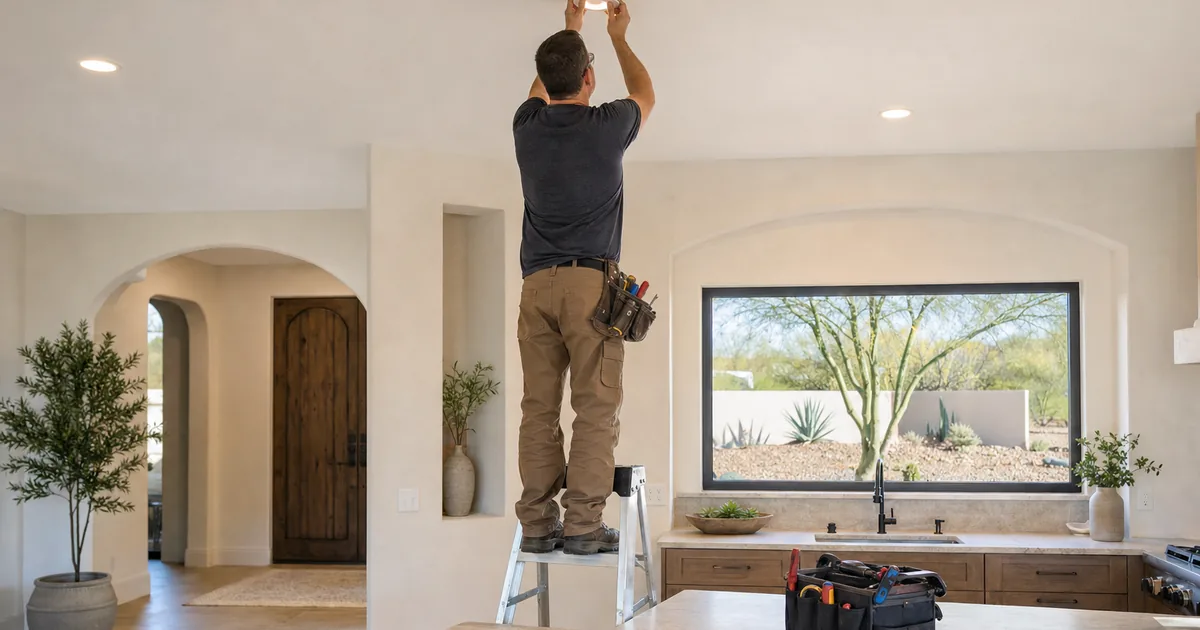
Most lighting installation in Mesa, AZ starts with a plain goal: a kitchen that is too dark at the counters, a living room with one ceiling light, a hallway that needs recessed cans, or a wish to put the whole house on dimmers and schedules. Some of that is a bulb or fixture change on wiring that already exists. Some of it adds circuits, switches and new fixture locations, which the City of Mesa treats as modifying an electrical system.
This guide explains that difference, what Mesa's permit page and plan-review checklist say about indoor lighting, what the U.S. Department of Energy and ENERGY STAR say about LEDs, brightness and controls, which utility programs apply in Mesa, and who does the work. It is written for single-family homes in Mesa.
Key takeaways
- The City of Mesa lists installing or modifying electrical systems as residential work that needs a construction permit, which covers new lighting circuits, new fixture locations and new switching.
- No City of Mesa document read for this page says whether a like-for-like fixture swap on an existing box needs a permit, so Mesa Permit Services at 480-644-4273 is the place to ask.
- An older City of Mesa single-family plan-review checklist requires recessed lighting to be IC-rated and minimum clearances to light fixtures in clothes closets.
- The U.S. Department of Energy says LEDs use at least 75% less energy and last up to 25 times longer than incandescent lighting.
- ENERGY STAR lists 1,100 lumens as the minimum light output for an LED that replaces a 75-watt incandescent bulb.
- The City of Mesa says SRP supplies electric service to about 90% of Mesa residents, and SRP offers LED bulb deals and instant rebates through SRP Marketplace.
What does lighting installation in a Mesa home include?
Lighting installation covers several different jobs, and they are not equal in scope, paperwork or risk. Sorting your project into one of them is the fastest way to know what to expect from the City of Mesa and from an electrician.
- Bulb and LED retrofits. Old incandescent, halogen or compact fluorescent bulbs are replaced with LED bulbs in the fixtures already in place. No wiring changes.
- Fixture replacement. A ceiling light, vanity bar, pendant or chandelier is replaced with a new fixture on an electrical box that already exists, controlled by the switch that already exists.
- New fixture locations. Recessed lights in a kitchen or family room, a pendant over an island, under-cabinet lights, or a ceiling light in a room that only had a switched outlet. New cable is run and new boxes or housings are cut in.
- New circuits. A dedicated lighting circuit for an addition, a remodeled kitchen or a converted garage, run from the panel.
- Switching and controls. Three-way switching for a hallway or stair, dimmers, occupancy sensors, timers, and whole home lighting control systems that put scenes and schedules on one keypad or app.
The first two are mostly about choosing the right product and mounting it safely. The last three change the electrical system of the house: they add cable, boxes, breakers or switching, and that is where Mesa's permit rule and its plan-review items come in. Indoor lighting installation is also a design question as much as a wiring one, because where a light sits decides how useful it is.
When we walk a Mesa home before pricing a lighting job, we often find that a room described as too dark has plenty of light output, but all of it comes from one fixture in the middle of the ceiling, so the counters, the desk or the reading chair sit in shadow. Adding light where the task happens usually does more than a brighter bulb in the same spot. For fans with light kits, see ceiling fan installation in Mesa; for porches, patios and security lights, see outdoor and security lighting in Mesa.
Does lighting installation in Mesa need a City permit?
It depends on which of those jobs you are doing. The City of Mesa's residential construction page lists the work that needs a construction permit, and two items on that list cover lighting projects that change wiring: "Interior structural, electrical, mechanical, or plumbing modifications" and "Installing or modifying electrical, plumbing, or mechanical systems." The same page lists what does not need a permit: painting, updating countertops and replacing flooring. Lighting is not on that no-permit list.
The City's residential construction FAQ adds two related lines. In an answer about solar, it says "new electric meters or circuits will require a permit," and in another answer it says no permit is needed "for interior work like painting, tiling, or carpeting." Read together, a new lighting circuit run from the panel is permit work, and so is cutting in new fixture locations and new switching, because that installs or modifies the electrical system.
One question the City's pages do not answer is whether replacing a fixture with a similar one on an existing box needs a permit. No Mesa document we read addresses a like-for-like swap, so this page does not tell you it is exempt. If your project sits anywhere near that line, ask City of Mesa Permit Services at 480-644-4273 or PermitServices@MesaAz.gov before work starts. For residential projects that go through plan review, the City says it returns written comments or an approval within 10 working days, and it offers an expedited 5-working-day review for an additional fee. The City's page does not say which lighting projects need full plan review, so that is another question for Permit Services rather than something to assume.
| Lighting job | Permit (our reading of City pages) | City of Mesa document | Utility angle |
|---|---|---|---|
| Swap bulbs for LEDs | Not addressed; no wiring is changed | None found | SRP customers: SRP Marketplace LED deals |
| Replace a fixture on an existing box | Not stated; ask Permit Services | None found (a gap in the City pages) | None listed |
| Add recessed lights or new fixture locations | Yes: installing or modifying electrical systems | Residential Construction page; plan-review checklist (IC-rated recessed lights) | ENERGY STAR certified downlights |
| Add a lighting circuit | Yes: new circuits require a permit | Residential Construction FAQ | None listed |
| Add switches, dimmers or a control system with new wiring | Yes, when wiring is added or changed | Residential Construction page | None listed |
| Light in a clothes closet | Part of the wiring work above | Plan-review checklist (closet fixture clearances) | None listed |
How we got this table. The permit column is our own reading of the City of Mesa Residential Construction page and its FAQ, read November 26, 2026; it is not a ruling by the City, and Permit Services decides your project. The checklist items come from an older City of Mesa single-family plan-review checklist that cites the 2018 code cycle. The utility column comes from the City's Savings and Rebates page and SRP's LED lighting rebates page, also read November 26, 2026; no rebate amounts are shown because neither page we read is used here for amounts.
Which code rules apply to indoor lighting in Mesa?
Mesa adopts the 2023 National Electrical Code with City amendments, and Article 80.1 of the City's amendment document names these regulations the Mesa Electrical Code, with the Building Safety Director or designee as the authority. City Council adopted the current set of codes in Ordinance No. 5979, which the ordinance says was "Passed and adopted by the City Council of the City of Mesa, Arizona, this 8th day of December, 2025." The 2024 International Codes and the 2023 National Electrical Code apply to permit applications submitted on or after January 8, 2026; projects already submitted before then stay under the earlier codes.
Mesa's amendment document changes a short list of national code sections, such as the marking of a service disconnect and the disconnect for large electric-vehicle chargers. On our reading of that list, Mesa did not amend Article 410, which covers luminaires, or section 210.70, which covers where lighting outlets are required, so those parts of the national code apply as published. That matters for lighting: the rules on how fixtures are supported, how they sit near insulation and combustible material, and which rooms and stairways need a switched light come from the national text, checked by a Mesa inspector.
The City has also published a single-family plan-review checklist with lighting items. It is an older document that cites the 2018 code cycle, so we describe it as Mesa's plan-review checklist rather than as the current rule. It says "Recessed lighting (IC rated) shall comply with N1102.4.5" and "90% high efficiency lighting shall comply with N1104.1." It asks plans to "Provide minimum clearances to light fixtures in clothes closets. E4003.12" and says "Interior stairways shall be provided with an artificial light source to illuminate the landings and treads." It also lists switched lighting at exterior doors and stairs. The current energy-code efficacy rule as Mesa amended it was not confirmed for this page, so we do not state a current percentage requirement.
Why does Mesa's checklist ask for IC-rated recessed lights?
IC stands for insulation contact. An IC-rated recessed housing is built to be covered by or touching ceiling insulation. ENERGY STAR notes that recessed downlights that are not IC-rated need clearance from insulation, which means an insulation gap around each can, and that gap is a path for air and heat between the attic and the room below. ENERGY STAR also says its certified downlights use 90% less energy than traditional models using incandescent bulbs.
On Mesa recessed-lighting jobs we check the attic side before cutting the first hole: where the joists run, how deep the insulation is, and whether ducts sit over the planned locations. Laying out cans from below and discovering a duct or joist afterward is how a neat grid turns into an uneven one. Many current LED downlights are thin wafer-style fixtures that mount in the ceiling without a separate can; whichever type is used, the rating on the product has to match how it is installed.
Why choose LED lighting installation in Mesa?
The short answer is energy and lifespan, with less heat as a side effect. The U.S. Department of Energy says residential LEDs, especially ENERGY STAR rated products, "use at least 75% less energy, and last up to 25 times longer, than incandescent lighting." DOE also notes that "LEDs emit very little heat." ENERGY STAR says its certified bulbs "Use up to 90% less energy than standard bulbs," last at least 15 times longer, and produce 70 to 90 percent less heat.
Heat from a light bulb is heat in the room. In a home where air conditioning runs for much of the year, a fixture that gives off less heat is, in our reading, one less small load on the cooling side as well as the lighting side. We do not put a number on that, because no source we read measures it for Mesa homes.
LED lighting installation is not only a bulb choice. Fixtures with built-in LEDs, recessed downlights, under-cabinet strips and LED vanity bars change how light is placed in a room, and they are rated as complete units. A few practical points decide whether the result looks right:
- Brightness is lumens, not watts. The next section shows the ENERGY STAR minimum lumens for each old bulb size.
- Color temperature is in kelvins. Lower numbers look warmer and more yellow; higher numbers look cooler and bluer. Keeping one color temperature across a room avoids a patchwork look.
- Dimming is not automatic. ENERGY STAR warns that "Not all ENERGY STAR certified bulbs are dimmable." A dimmable LED also needs a dimmer that is compatible with it.
- Task light beats more overhead light. The City of Mesa's own energy tips say "Turn off unnecessary lighting and use task or desktop lamps with LEDs instead of overhead lights."
How bright should an LED be to replace an old bulb?
Because LEDs draw far fewer watts, the old habit of shopping by wattage no longer works. ENERGY STAR publishes minimum light output, in lumens, for a bulb that replaces each common incandescent size. Use the lumens figure on the package to match what the room had, then decide whether the room actually needs more.
| Old incandescent bulb | ENERGY STAR minimum lumens | Lumens per watt of the old bulb (our arithmetic) |
|---|---|---|
| 40 watts | 450 | 11.3 |
| 60 watts | 800 | 13.3 |
| 75 watts | 1,100 | 14.7 |
| 100 watts | 1,600 | 16.0 |
| 150 watts | 2,600 | 17.3 |
How we got this table. The wattage and lumens columns come from the ENERGY STAR ceiling fans product page, read November 26, 2026; they are minimum equivalents for a replacement bulb, not measured output of any particular product. The right-hand column is our own arithmetic (minimum lumens divided by the old wattage, rounded to one decimal) and shows that larger incandescent bulbs gave slightly more light per watt, which is why the lumens step up unevenly between sizes.
A practical rule follows from the table: if a room felt right with 60-watt bulbs, look for at least 800 lumens per bulb; if it always felt dim, the fix may be a 1,100-lumen bulb or, often better, a second light source where the work happens.
What is a whole home lighting control system, and is it worth it in Mesa?
A whole home lighting control system lets you control many lights from one place: keypads that set scenes, schedules that switch lights at set times, sensors that turn lights on and off with occupancy, and an app that does the same from a phone. Some systems replace each wall switch with a smart dimmer; others use a central controller wired to groups of circuits. Smart home lighting in Mesa can be as small as a few smart dimmers in the rooms used most, or as large as a system covering every room.
The energy case rests on two simple controls that DOE describes. DOE says "When you dim lightbulbs, it reduces their wattage and output, which helps save energy," and it describes timers as a way to switch lights on and off at set times. The City of Mesa's energy tips make a similar point: "Use smart or programmable features to help maintain energy savings when you're not home." No DOE or ENERGY STAR page we read measures savings for specific smart or Wi-Fi lighting systems, so this page makes no savings claim for any particular product.
Whether a system is worth it is mostly a convenience and layout question. Points to settle before buying hardware:
- Wiring at the switch. Many smart switches and dimmers need a neutral conductor in the switch box. Whether one is there decides which products fit without new wiring.
- Dimmer and bulb compatibility. A dimmer and the LEDs it controls have to work together; mismatches show up as flicker, buzzing or lights that will not dim low.
- Multi-way switching. Hallways and stairs with switches at both ends need products made for multi-location control.
- Permit scope. Swapping a switch for a smart one on existing wiring is different from running new cable for keypads or a controller; new wiring is the kind of modification the City lists as permit work.
When we install smart dimmers in Mesa homes, we often find the switch box is the limiting factor rather than the product: the box is crowded, or the wiring at that location does not match what the device expects. Checking the boxes first saves returning a box of devices that will not fit.
Which utility programs help with LED lighting in Mesa?
Two electric utilities serve Mesa homes, and only one of them lists a lighting program on the pages we read. The City of Mesa's Savings and Rebates page says "Salt River Project (SRP) supplies electric service to about 90% of Mesa residents," and it links to SRP's residential rebates and to SRP Marketplace. SRP's LED lighting page tells customers to "Find special deals, instant rebates and seasonal promotions when you shop for LED bulbs on SRP Marketplace." The page covers ENERGY STAR certified LED bulbs; this guide does not state amounts, because offers change and none are used here.
City of Mesa Electric, the City's own utility, serves an area of about 5.5 square miles centered on downtown Mesa. Its electric page lists an electric vehicle time-of-use rate, a renewable energy service rider and a solar program; no lighting rebate is listed there. Customers with questions can contact the City's energy office at 480-644-4444 or energyresourcesinfo@mesaaz.gov. The name on your electric bill tells you which utility you have. For a side-by-side of both, see City of Mesa Electric and SRP explained.
What happens on the day of an indoor lighting installation in Mesa?
The order of work is much the same on most indoor lighting jobs. The circuit is switched off at the breaker and tested dead before anything is touched. For a fixture replacement, the old fixture comes down, the box and its support are checked, and the new fixture is mounted to a box rated for its weight. Heavy chandeliers and ceiling fans need boxes and supports made for them; a box meant for a light fixture is not a fan support.
For new recessed lights or new fixture locations, the layout is marked, the attic or ceiling cavity is checked, holes are cut, cable is run from a power source to the new switch and fixtures, and each housing or wafer light is connected and secured. For a new circuit, cable runs back to the panel and a new breaker is added. If the panel has no room for another breaker or the load calculation is close, that becomes a separate conversation; see electrical panel upgrade in Mesa. Where a permit applies, the work is left ready for the City inspection before ceilings are closed or trims are finished.
Read the instructions on pendants and heavy fixtures before lifting them. In May 2026 the U.S. Consumer Product Safety Commission announced a recall of about 170 Minka Bardon Series pendant fixtures, warning that "The recalled light fixture's frame can detach from the pendant downrod during installation." CPSC lists a refund as the remedy and Minka Lighting Group's contact number as 888-390-3989. Checking a new fixture against current recalls before it goes up takes a minute.
If lights already flicker, dim when an appliance starts, or a switch feels warm, that is a fault to diagnose before adding more lighting to the same circuit. Those problems are covered on electrical repair and troubleshooting in Mesa.
What are the most common mistakes with lighting installation in Mesa?
- Assuming new wiring needs no permit. The City of Mesa lists installing or modifying electrical systems as permit work, and its FAQ says new circuits require a permit.
- Using non-IC-rated recessed lights against insulation. Mesa's plan-review checklist calls for IC-rated recessed lighting, and ENERGY STAR says non-IC-rated models need clearance from insulation.
- Buying bulbs by watts. LED wattage does not describe brightness; ENERGY STAR's lumens equivalents do.
- Putting non-dimmable LEDs on a dimmer. ENERGY STAR warns that not all certified bulbs are dimmable, and an incompatible pairing tends to flicker or buzz.
- Hanging a heavy fixture or fan from a light-only box. The box and its support have to be rated for the weight and type of fixture.
- Mixing color temperatures in one room. Bulbs with different kelvin ratings make a room look patchy; pick one and keep it.
Who does lighting installation work in Mesa?
The City of Mesa's residential construction page says owner-occupied projects may not require a licensed contractor, and it refers homeowners to the Arizona Registrar of Contractors guidelines on that point. A bulb change is a homeowner task. Running new circuits, cutting in recessed lights and rewiring switch locations is electrical work that, where a permit applies, has to pass a City inspection, and the circuit you work on has to be switched off and confirmed dead first, which is why many homeowners hire a licensed electrical contractor for anything beyond a bulb.
Before hiring anyone, ask three things: the contractor's Arizona license number and classification, who will take out the City of Mesa permit if one is needed, and how they will confirm that the dimmers, switches and fixtures they install are compatible. A contractor who does lighting work regularly can answer all three on the spot.
Lighting installation requested through Your Mesa Electrician is performed by Alvey Electric LLC, Arizona Registrar of Contractors license ROC 364723 (R-11, residential), a residential electrical contractor. The work is residential only.
Frequently asked questions
Do I need a permit to install new lights in Mesa?
Usually, when the work adds or changes wiring. The City of Mesa lists installing or modifying electrical systems and interior electrical modifications as work that needs a construction permit, and its FAQ says new circuits require a permit. New recessed lights, new fixture locations, new switching and new lighting circuits fall under that. Questions about a specific project go to City of Mesa Permit Services at 480-644-4273 or PermitServices@MesaAz.gov.
Do I need a permit to replace a light fixture in Mesa?
No City of Mesa document we read says whether swapping one fixture for a similar one on an existing box needs a permit, so this page does not call it exempt. The City's no-permit list names painting, countertops and flooring, not lighting. If the swap involves new wiring, a new box location or a heavier fixture that needs new support, treat it as electrical modification and ask Mesa Permit Services.
How much does lighting installation cost in Mesa?
This page does not quote a price because no public source sets one. The cost depends on the number of fixtures, whether they go in existing locations or new ones, whether new cable or a new circuit has to be run, attic access and ceiling type, the control system chosen, whether a City permit is needed, and how much drywall or ceiling repair follows. A written estimate after a site visit is the reliable number.
What does IC-rated mean for recessed lights?
IC means insulation contact. An IC-rated recessed fixture is built to be in contact with ceiling insulation. An older City of Mesa plan-review checklist says recessed lighting shall be IC-rated, and ENERGY STAR notes that recessed downlights that are not IC-rated need clearance from insulation. That clearance leaves a gap around each fixture, which is why IC-rated products are the usual choice under an insulated attic.
How many lumens do I need to replace a 60-watt bulb?
ENERGY STAR lists 800 lumens as the minimum for a bulb that replaces a 60-watt incandescent. Its other minimums are 450 lumens for a 40-watt bulb, 1,100 lumens for 75 watts, 1,600 lumens for 100 watts and 2,600 lumens for 150 watts. Shop by the lumens on the package, because an LED's wattage is far lower and no longer tells you how bright it is.
Are LED lights worth it in a Mesa home?
For most fixtures, yes, on energy and lifespan. The U.S. Department of Energy says LEDs use at least 75% less energy and last up to 25 times longer than incandescent lighting, and that they emit very little heat. ENERGY STAR says certified bulbs produce 70 to 90 percent less heat. The main things to check are brightness in lumens, color temperature and whether the bulb is dimmable.
Can I put LED bulbs on a dimmer?
Only if both the bulb and the dimmer are made for it. ENERGY STAR warns that not all certified bulbs are dimmable, so check the package. A dimmable LED also needs a compatible dimmer; a mismatch often shows up as flicker, buzzing or lights that will not dim smoothly. DOE notes that dimming reduces a bulb's wattage and output, which helps save energy.
What is a whole home lighting control system?
A whole home lighting control system controls many lights from one place, using keypads, schedules, sensors or an app. Some systems replace wall switches with smart dimmers; others use a central controller wired to groups of circuits. DOE describes dimmers and timers as ways to save energy, and the City of Mesa suggests smart or programmable features. New wiring for keypads or controllers is electrical modification and may need a permit.
Does SRP or City of Mesa Electric offer LED lighting rebates?
SRP does. The City of Mesa says SRP supplies electric service to about 90% of Mesa residents, and SRP offers special deals, instant rebates and seasonal promotions on LED bulbs through SRP Marketplace. City of Mesa Electric, which serves about 5.5 square miles around downtown, lists an EV time-of-use rate, a renewable energy rider and a solar program on its electric page, but no lighting rebate.
What electrical code does Mesa use for lighting work?
Mesa uses the 2023 National Electrical Code with City amendments, called the Mesa Electrical Code. Under Ordinance No. 5979, adopted December 8, 2025, the 2024 International Codes and the 2023 NEC apply to permit applications submitted on or after January 8, 2026. On our reading, Mesa's amendments do not change Article 410 on luminaires or section 210.70 on required lighting outlets, so those apply as published.
Who does lighting installation work requested through Your Mesa Electrician?
Lighting installation requested through Your Mesa Electrician is performed by Alvey Electric LLC, Arizona Registrar of Contractors license ROC 364723 (R-11, residential), a residential electrical contractor. The work covers indoor fixtures, recessed and LED lighting, switching and lighting controls in single-family homes. The work is residential only.
The short version
Decide first whether your project only changes bulbs and fixtures or also adds wiring, because new circuits, locations and switching are the work Mesa lists as needing a permit. Choose LEDs by lumens and color temperature, confirm dimmer compatibility before ceilings are closed, and use IC-rated fixtures wherever insulation is present. If SRP serves the house, check SRP Marketplace before buying bulbs.
This page is general information about residential electrical work in Mesa, Arizona. It is not engineering, legal or code advice for a specific property. Permit rules, utility requirements and adopted codes change; confirm current requirements with the City of Mesa and your electric utility before work begins.
References
- City of Mesa Development Services, Residential Construction (permit list, review times, Permit Services contact) https://www.mesaaz.gov/business/development-services/residential-construction. Read November 26, 2026.
- City of Mesa, Residential Construction FAQ https://www.mesaaz.gov/Business-Development/Development-Services/Building-Permit-Plan-Review/Residential-Construction/Residential-Construction-FAQ. Read November 26, 2026.
- City of Mesa Development Services, Single Family Dwelling Requirements (plan-review checklist, 2018 code cycle) https://mesaaz.gov/home/showpublisheddocument/37094/637949511493700000. Read November 26, 2026.
- City of Mesa, Amendments to the 2023 National Electrical Code (Mesa Electrical Code) https://www.mesaaz.gov/files/assets/public/v/3/business-development/devsvcs/codeamendments/2023-nec-amendment.pdf. Read November 26, 2026.
- City of Mesa, Ordinance No. 5979, adopted December 8, 2025 https://mcclibraryfunctions.azurewebsites.us/api/ordinanceDownload/15749/1399976/pdf. Read November 26, 2026.
- City of Mesa, Savings and Rebates https://www.mesaaz.gov/Utilities/Savings-Rebates. Read November 26, 2026.
- Salt River Project, LED lighting rebates https://www.srpnet.com/energy-savings-rebates/home/rebates/led-lighting. Read November 26, 2026.
- City of Mesa, Electric utility page (service area, programs, contact) https://www.mesaaz.gov/Utilities/Energy/Electric. Read November 26, 2026.
- City of Mesa, Energy Saving Tips https://mesaaz.gov/residents/energy/energy-saving-tips. Read November 26, 2026.
- U.S. Department of Energy, Energy Saver: LED Lighting https://www.energy.gov/energysaver/led-lighting. Read November 26, 2026.
- U.S. Department of Energy, Energy Saver: Lighting Controls https://www.energy.gov/energysaver/lighting-controls. Read November 26, 2026.
- ENERGY STAR, Light Bulbs https://energystar.gov/lighting. Read November 26, 2026.
- ENERGY STAR, Light Fixtures https://www.energystar.gov/products/light_fixtures. Read November 26, 2026.
- ENERGY STAR, Ceiling Fans (lumens by incandescent wattage) https://www.energystar.gov/products/ceiling_fans. Read November 26, 2026.
- U.S. Consumer Product Safety Commission, Minka Lighting Group Recalls Bardon Series Pendant Light Fixtures (May 14, 2026) https://cpsc.gov/Recalls/2026/Minka-Lighting-Group-Recalls-Bardon-Series-Pendant-Light-Fixtures-Due-to-Risk-of-Serious-Injury-or-Death-from-an-Impact-Hazard. Read November 26, 2026.
Plan your lighting project
Request a written estimate for new fixtures, recessed lights or lighting controls in your Mesa home.
Related pages
About this page
Written by the Your Mesa Electrician editorial team from the sources listed above. Reviewed by Robert "Bob" Lira, licensed Arizona electrical contractor, ROC 338369. Your Mesa Electrician, 1740 S Robin Ln, Mesa, AZ 85204, phone 480-701-4348, serves homes in the City of Mesa. Electrical work is performed by Alvey Electric LLC, Arizona Registrar of Contractors license ROC 364723 (residential electrical).
Updated .