Residential electrical service - Mesa, Arizona
EV Charger Installation Mesa AZ: Permits, Panels and Utility Rates (2026 Guide)
How a home EV charger is wired, what the City of Mesa permit and checklist require, and how City of Mesa Electric and SRP rates shape when and how fast you charge.
Quick answer
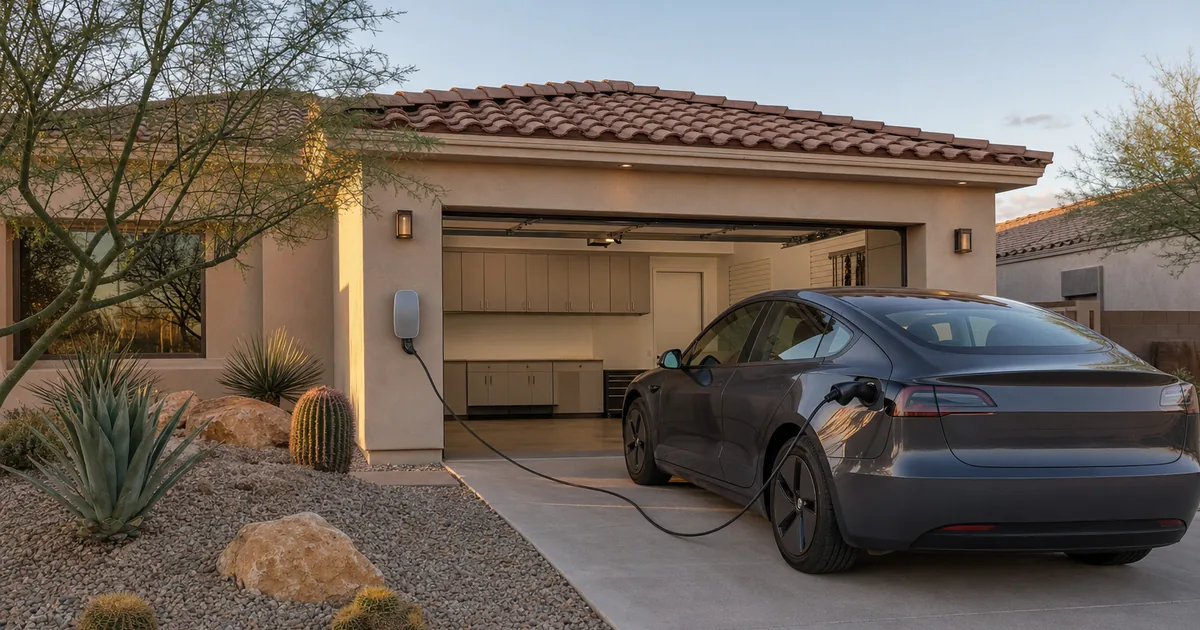
EV charger installation in Mesa usually means adding a dedicated 240-volt Level 2 circuit, which the U.S. Department of Energy says adds about 25 miles of range per hour versus about 5 for a 120-volt outlet. The City of Mesa treats new electrical circuits as permit work, and its residential EV checklist asks for a panel schedule and load calculations. The utility matters too: City of Mesa Electric offers an EV time-of-use rate, while SRP serves the rest of the city with its own plans.
People who look up EV charger installation Mesa options usually have an electric car on order or already parked in the garage, and they want three answers: whether the house can carry a charger, what the City of Mesa requires, and how to charge during the lowest-priced hours. This guide answers each question from City of Mesa documents, SRP's own pages and the U.S. Department of Energy, and it is written for single-family homes in Mesa.
An electric car charger installation in Mesa has one local twist that general guides miss: the city has two electric utilities. Which one serves your address decides which EV rate you can apply for, which charging window you are aiming at, and what your charger needs to be able to do. That is why this page treats the utility as part of the installation rather than an afterthought.
Key takeaways
- The City of Mesa lists installing or modifying electrical systems as residential work that needs a building permit, which covers a new 240-volt charger circuit.
- Mesa's residential EV charger checklist requires an individual branch circuit for EV outlets and a complete panel schedule with load calculations for all appliances.
- The U.S. Department of Energy's Alternative Fuels Data Center says Level 2 home charging adds about 25 miles of range per hour, against about 5 miles for Level 1.
- City of Mesa Electric's Electric Vehicle Time of Use Rate sets a super off-peak home-charging window from 11 PM to 5 AM and is open to customers with a programmable EV charger.
- SRP's dedicated EV Price Plan is closed to new enrollments, and SRP's EV page now features plans such as one with a super off-peak period from 8 a.m. to 3 p.m. every day.
- Under Mesa's amendment to NEC section 625.43, charging equipment over 60 amps or over 150 volts to ground needs a lockable disconnect 15 to 50 feet from the equipment.
What does EV charger installation in Mesa involve?
A home EV charger installation adds a circuit, and usually a piece of wall-mounted equipment, so a car can charge faster or more conveniently than it can from an ordinary household outlet. The wall unit is properly called electric vehicle supply equipment, or EVSE; most homeowners simply call it the charger, and so does this page.
The U.S. Department of Energy's Alternative Fuels Data Center (AFDC) groups charging into three levels. Level 1 "provides charging through a 120 volt (V) AC plug." Level 2 runs at "240 V (typical in residential applications) or 208 V (typical in commercial applications)," which at a house means a dedicated 240-volt circuit from the panel. DC fast charging is the third level, and the AFDC describes it as equipment for heavy-traffic corridors, not something installed at a home.
That leaves a Mesa homeowner with three realistic jobs:
- A hardwired Level 2 unit. The charger is mounted on a garage wall or exterior wall and wired directly to a new 240-volt circuit.
- A 240-volt receptacle. A dedicated outlet is installed for a plug-in Level 2 charger or for a portable cord that supports 240 volts.
- A Level 1 check. An existing 120-volt outlet is tested and, where needed, given its own circuit so it can carry long charging sessions safely.
The AFDC's home-charging page puts the electrician's role plainly: "a qualified electrician can add circuits to accommodate the capacity needed for Level 2 charging." The rest of this page covers what that takes in Mesa: the City permit and checklist, the panel, the utility rate, the local code amendment, and where the equipment should go. For general outlet work that is not tied to a car, see outlet installation and repair in Mesa.
Level 1 or Level 2: which charger makes sense for a Mesa home?
The practical difference between the two home options is speed. The AFDC says Level 1 adds approximately 5 miles of range per hour of charging, based on a power level of about 1.9 kilowatts. Level 2 adds approximately 25 miles of range per hour; the AFDC says most residential Level 2 units deliver 7.2 kilowatts, within a wider span of 2.9 to 19.2 kilowatts depending on the equipment. The AFDC lists the J1772 connector for Level 2, along with the J3400 connector, also known as NACS, used by Tesla.
Those per-hour figures matter more once charging is squeezed into a rate window. On the City of Mesa Electric EV rate, the super off-peak home-charging window runs from 11 PM to 5 AM, which is six hours. The last column of the table below is our own arithmetic: the AFDC's hourly figures multiplied by those six hours, which gives roughly 30 miles for Level 1 and roughly 150 miles for Level 2. Actual results vary by vehicle and equipment, so treat that column as a planning illustration, not a promise.
| Level | Voltage | Typical power (AFDC) | Range per hour (AFDC) | Range in a 6-hour 11 PM to 5 AM window (our arithmetic) |
|---|---|---|---|---|
| Level 1 | 120 V AC plug | About 1.9 kW | About 5 miles | About 30 miles |
| Level 2 | 240 V in homes | Most residential units 7.2 kW (span 2.9 to 19.2 kW) | About 25 miles | About 150 miles |
| DC fast | Not given | Up to 500 kW | About 100 to 200+ miles per 30 minutes | Not a home option |
How we got this table. The voltage, power and range figures come from the U.S. Department of Energy Alternative Fuels Data Center page Developing Infrastructure to Charge Electric Vehicles (undated, read November 26, 2026). The 11 PM to 5 AM window is the super off-peak period on the City of Mesa Electric Vehicle Time of Use Rate page. The last column is our arithmetic (hourly range times six hours), not measured data; real charging varies by vehicle. No prices are shown because no public source sets one.
Does EV charger installation in Mesa need a City permit?
Plan on yes whenever a new circuit is added. The City of Mesa's residential construction page lists installing or modifying electrical, plumbing or mechanical systems among the work that needs a building permit, and a new 240-volt charger circuit modifies the electrical system. The AFDC gives the same general warning for any community: "Appropriate permits may be required from the local building and permitting authorities."
Mesa takes permit applications online. The City's Residential Construction Homeowners Guide, dated March 2025, tells applicants to "Create an account and Apply for a Permit online through the DIMES system," and states that "All permitted residential projects require inspections at each stage of construction." According to the same guide, "Inspections are normally conducted the following day between 6:30 am and 5:00 pm Monday - Friday."
What the City's pages do not say is whether a residential EV charger goes through full plan review or a faster path. For residential projects that do go through plan review, the City says it returns written comments or an approval within 10 working days, with an expedited review of 5 working days available for an additional fee. Ask City of Mesa Permit Services at 480-644-4273 or PermitServices@MesaAz.gov how your project will be handled instead of assuming either path. Questions about the City's EV ordinance itself go to the contact the City lists on its EV charger requirements document, John Sheffer, at (480) 644-5879, or to the Building Safety Division at (480) 644-3145.
The residential construction page also notes that owner-occupied projects may not require a licensed contractor, and it refers homeowners to the Arizona Registrar of Contractors guidelines. The permit, the load calculation and the inspections apply whoever does the work.
What does Mesa's residential EV charger checklist ask for?
Mesa publishes a document titled "RESIDENTIAL ELECTRIC VEHICLE (EV) CHARGER PLAN SUBMITTAL CHECKLIST," written against the 2024 International Residential Code and International Energy Conservation Code with City of Mesa amendments. It is the clearest public statement of what the City expects to see for a home charger, and it reads almost like a job description:
- Project basics. A project narrative, the site address, a vicinity map, a dimensioned site plan and the manufacturer's specification sheets.
- The panel. "Identify location, size and capacity of electrical service panel." The checklist also says: "Provide complete panel schedule and load calculations for all appliances. (IRC E3706.2; Table E3602.2)"
- The circuit. "Outlets installed for charging electric vehicles (EVs) shall be supplied by an individual branch circuit." and "Each circuit shall not supply other outlets. (IRC E3702.14)"
- The route. "Show location of raceway, circuit capacity, circuit type (e.g. AFCI), wiring size, type and run length,"
- The parking space. "Provide separation distance(s) between charging station(s) and vehicle parking spot(s)."
The checklist also prints a table that pairs a charger's load with a breaker size and a minimum wire size. Two of its rows are reproduced below, with our reading of what each means for the job.
| Charger load | Breaker | Copper wire | Aluminum wire | What it means on the job (our reading) |
|---|---|---|---|---|
| 31 to 40 A | 40 A | 8 gauge | 6 gauge | A lower charger setting keeps the breaker and wire one size smaller and uses less of the panel's spare capacity |
| 41 to 50 A | 50 A | 6 gauge | 4 gauge | A higher setting moves both the breaker and the wire up a size; confirm the load calculation can carry it before choosing it |
How we got this table. The first four columns are two rows copied from the City of Mesa Residential EV Charger Plan Submittal Checklist (no date or revision shown, read November 26, 2026); the checklist's other rows are not reproduced. The right-hand column is our own reading, not a City interpretation; the plan reviewer and inspector decide what is acceptable, and the run length shown on the plan still has to be checked.
Does your Mesa home have enough panel capacity for a Level 2 charger?
The checklist's demand for a complete panel schedule and load calculations for all appliances is the City's way of asking exactly this question. A Level 2 charger is a large load that can run for hours, and it is added to a service that already carries the air conditioning, cooking, laundry, water heating and any pool or spa equipment. The load calculation shows whether the existing service has room for one more large, long-running load.
The answer usually lands in one of three places:
- Room to spare. The calculation shows enough capacity and the panel has a free breaker space. The job is a new circuit and the charger.
- Capacity, but a tight panel. The service can carry the load but the breaker spaces are taken, so circuits have to be reorganized or a subpanel added.
- Not enough capacity. The choice is a load-management device that limits charging while other big loads run, a lower charger setting, or a service upgrade.
The AFDC's span of 2.9 to 19.2 kilowatts for Level 2 shows how much equipment varies, and under the checklist table above a lower charger setting calls for a smaller breaker and wire. That flexibility is often what lets a charger fit an existing service. When it does not, the larger project is covered on electrical panel upgrade in Mesa.
On Mesa EV jobs we regularly find that the question homeowners ask first (which charger to buy) is easier than the question the panel asks (how much room is left), so we answer the panel's question first. We read the panel label, fill in the schedule and run the calculation before anyone settles on a charger amperage. If a breaker on the panel already trips under today's loads, that gets fixed before a charger is added; see circuit breaker repair in Mesa.
Which utility serves your Mesa home, and how does it change EV charging rates?
Mesa has its own municipal electric utility. According to the City's electric utility page, City of Mesa Electric serves an area of about 5.5 square miles centered around downtown Mesa. SRP serves the rest of the city, and the City's own pages draw that line: its electric design and construction standards say they do not apply to SRP electric customers, and its EV rate page tells them, "SRP customers, please visit the SRP website." The quickest way to know is the name on your electric bill.
City of Mesa Electric customers. The City offers an Electric Vehicle Time of Use Rate, which it describes as an incentive for EV drivers in its electric service area to shift charging to the hours when electricity is lowest-priced. It is aimed at "Customers with an EV or plug-in hybrid electric vehicle (PHEV) and programmable EV charger," and the City adds that "You own or lease a qualified battery electric or plug-in hybrid electric vehicle." The City says "You can charge your EV at home between 11PM and 5AM" in the super off-peak period, and it warns that the time-of-use pricing reaches beyond the car: "This applies to your EV as well as pool equipment and any other large appliance." The application asks for a "Copy of the current registration for your EV or PHEV," the charging address, and the "Make and model of your electric vehicle charger (the actual charger or "EVSE" installed in your home)" "or proof of 240V outlet." The City's page shows its on-peak hours only in an image, so they are not repeated here; check the page before you apply.
SRP customers. SRP's dedicated EV plan has closed: "This price plan is no longer available for new enrollments," and SRP says it "will be discontinued as of, or before, the November 2029 billing cycle." SRP's EV page now features two plans. Conserve 6-9 P.M. and Save has a super off-peak period from 8 a.m. to 3 p.m. every day. Manage Demand 5-10 P.M. and Save adds a demand charge based on the highest 30-minute use during the 5 to 10 p.m. weekday peak, and SRP says it is "best suited for customers who can avoid using large appliances and charging their EV during on-peak hours." SRP also runs SRP EV Smart Charge, which schedules charging into lower-cost super off-peak or off-peak periods for an eligible vehicle or charger. SRP says customers can switch plans online "or call (602) 236-8888 to make the switch."
| Item | City of Mesa Electric area | SRP area | What it means for the install (our reading) |
|---|---|---|---|
| Who serves the home | About 5.5 square miles centered around downtown Mesa | The rest of the city; the City's EV page sends SRP customers to SRP | Check the bill before choosing a charger |
| EV rate or plan | Electric Vehicle Time of Use Rate (City) | EV Price Plan closed to new enrollments; Conserve and Manage Demand plans featured | The rate you can actually join sets the charging window |
| Lowest-priced charging window | Super off-peak 11 PM to 5 AM | Conserve plan: super off-peak 8 a.m. to 3 p.m. every day | A charger with a schedule setting can follow either window |
| Charger requirement | Programmable EV charger; EVSE make and model or proof of a 240V outlet on the application | EV Smart Charge needs an eligible vehicle or charger | Keep the charger model and permit paperwork on file |
| Whole-home effect | Rate applies to pool equipment and other large appliances too | Manage Demand: demand charge on highest 30-minute use, 5 to 10 p.m. weekdays | Avoid stacking charging on top of other big loads at peak |
How we got this table. The middle columns come from the City of Mesa electric utility page and Electric Vehicle Time of Use Rate page, and from SRP's Electric Vehicle Price Plan, Find a price plan (EV) and EV Smart Charge pages, all undated and read November 26, 2026. The right-hand column is our reading of how each point affects the installation; it is not utility guidance. Rate prices are not shown because this page does not quote prices, and the City's on-peak hours are not given because they appear only in an image.
A side-by-side of the two utilities for other jobs is on City of Mesa Electric and SRP explained.
What does the Mesa Electrical Code require for EV charger disconnects?
Mesa adopts the 2023 National Electrical Code with City amendments, and Article 80.1 of the City's amendment document says "These regulations shall be known as the "Mesa Electrical Code,"" with the "Building Safety Director or designee" as the authority. The City's building code page says its current codes, the 2024 International Codes together with the 2023 National Electrical Code, apply to permit applications submitted on or after January 8, 2026, and that projects already submitted, under review or under construction are not affected.
One Mesa amendment speaks directly to EV equipment. Under the City's version of section 625.43, charging equipment rated over 60 amps or over 150 volts to ground needs a disconnect "not less than 15 feet (4,572 mm) or more than 50 feet (9,144 mm) from the equipment," with a plaque, and lockable in the open position. Mesa's general Electrical Plan Submittal Checklist repeats the rule: "For EVSE over 60A or 150V to ground, provide disconnect 15 to 50 feet from equipment. (M-NEC 625.43)"
Whether a given home charger crosses either threshold depends on its rating, which is why the residential checklist asks for the manufacturer's specification sheets. For a charger that does, the disconnect location becomes a design decision: it has to sit inside that 15-to-50-foot band, be reachable, and be marked. Planning it on paper first avoids moving it after the inspector measures. Two other Mesa amendments often come up in the same garage: section 210.52(G)(1) calls for a receptacle in each vehicle bay, 18 to 66 inches above the floor, and section 230.70(B) says plastic tape is not durable marking for a service disconnect.
Where should an EV charger go in a Mesa garage or driveway?
The checklist's requirement to show the separation distance between the charging station and the parking spot is a reminder that location is part of the permit, not a detail for the install day. A few practical rules follow from it:
- Match the car, not the wall. Mount the charger where the cable reaches the car's charging port without stretching across a walkway or being driven over.
- Shorten the run where you can. The checklist asks for the wire run length, and a long run from a far-side panel can call for heavier wire. A charger near the panel is often the simpler job.
- Think about a second car. If another electric vehicle is likely, say so before the load calculation, so the circuit and panel plan allow for it.
- Outdoor units. A driveway or carport location needs equipment and wiring methods suited to outdoor use, and the disconnect rule above still applies where the charger's rating triggers it.
What happens on installation day and at the City of Mesa inspection?
Once the permit is issued, a typical Level 2 install follows a short sequence. Power to the affected panel is shut off. The breaker is installed in the space the panel schedule reserved, and the circuit is run along the raceway route shown on the plan, using the wire size the checklist table and the run length call for. The charger is mounted at the planned location, or a 240-volt receptacle is installed for a plug-in unit, and the disconnect goes in where the Mesa amendment requires one. The panel directory is updated so the new circuit is labeled.
Inspections follow the City's process. The Homeowners Guide says permitted residential projects are inspected at each stage of construction and that inspections are normally conducted the day after they are requested, between 6:30 am and 5:00 pm on weekdays. A charger is not ready for daily use until the work has passed. After that, set the charger's schedule to the window your utility rate rewards, and, for City of Mesa Electric customers, keep the charger's make and model handy for the EV rate application.
For a broader look at the rest of the house before or after a charger is added, see home electrical inspections in Mesa.
What are the most common mistakes with EV charger installation in Mesa?
- Buying the charger before reading the bill. The City's EV rate is open to customers with a programmable charger, and SRP's plans reward specific hours. Know your utility and plan first.
- Skipping the load calculation. Mesa's checklist asks for a complete panel schedule and load calculations for all appliances. A charger added on guesswork can overload the service.
- Sharing the circuit. The checklist says EV outlets must be on an individual branch circuit that supplies no other outlets.
- Ignoring the disconnect band. For equipment over 60 amps or 150 volts to ground, Mesa wants the disconnect 15 to 50 feet from the charger, lockable and marked.
- Charging on top of peak loads. The City's EV rate applies to pool equipment and other large appliances as well, and SRP's Manage Demand plan bills on the highest 30-minute use at peak.
- Leaving out the permit. The City lists modifying electrical systems as permit work, and the EV rate application asks for proof of the installed EVSE or 240V outlet.
Who installs EV chargers requested through Your Mesa Electrician?
Arizona licenses contractors through the Registrar of Contractors, and the City of Mesa's residential construction page says owner-occupied projects may not require a licensed contractor, referring homeowners to the Registrar's guidelines. Before hiring anyone for a charger circuit, ask four things: the license number and classification, who takes out the City of Mesa permit, whether a load calculation and panel schedule will be prepared for the checklist, and whether the plan accounts for your utility's charging window.
EV charger installations requested through Your Mesa Electrician are performed by Alvey Electric LLC, Arizona Registrar of Contractors license ROC 364723 (R-11, residential). The work is residential only.
Frequently asked questions
Do I need a permit to install an EV charger in Mesa?
Yes, when a new circuit is added. The City of Mesa lists installing or modifying electrical systems among residential work that needs a building permit, and a 240-volt charger circuit modifies the electrical system. Mesa takes applications online through its DIMES system, and its residential EV checklist asks for a panel schedule, load calculations and a site plan. Questions go to City of Mesa Permit Services at 480-644-4273.
How much does EV charger installation cost in Mesa?
This page does not quote a price because no public source sets one. The cost depends on whether the panel has spare capacity and a free breaker space, the charger setting and the breaker and wire size it requires, the distance from the panel to the parking spot, whether a disconnect is needed under Mesa's 625.43 amendment, and whether a service upgrade or load management is needed. A written estimate after a load calculation is the reliable number.
How fast does a Level 2 charger charge compared with a regular outlet?
According to the U.S. Department of Energy's Alternative Fuels Data Center, Level 1 charging from a 120-volt plug adds approximately 5 miles of range per hour, while Level 2 at 240 volts adds approximately 25 miles per hour, with most residential units delivering 7.2 kilowatts. In a six-hour window from 11 PM to 5 AM, our arithmetic gives roughly 30 miles for Level 1 and 150 miles for Level 2.
Can I charge my electric car from a regular 120-volt outlet in Mesa?
Yes, that is Level 1 charging, and the Alternative Fuels Data Center says it adds about 5 miles of range per hour. It can work for short daily driving. The outlet should be in good condition and, ideally, on its own circuit, because long charging sessions load it for hours. If you drive farther or must fit a short rate window, Level 2 is the more practical choice.
Do I need a panel upgrade to install an EV charger in Mesa?
Not always. Mesa's residential EV checklist asks for a complete panel schedule and load calculations for all appliances, and that calculation answers the question. If the service has room, the job is a new circuit. If it does not, the options are a lower charger setting, a load-management device, or a service upgrade. The panel's free breaker spaces matter as well as its capacity.
Does the City of Mesa have an EV electricity rate?
Yes, for City of Mesa Electric customers. The City's Electric Vehicle Time of Use Rate is for customers with an EV or plug-in hybrid and a programmable EV charger, and its super off-peak home-charging window runs from 11 PM to 5 AM. The City says the time-of-use pricing also applies to pool equipment and other large appliances. The application asks for your EV registration and the installed charger's make and model or proof of a 240V outlet.
What EV price plans does SRP offer to Mesa customers?
SRP's dedicated EV Price Plan is closed to new enrollments and will end by the November 2029 billing cycle. SRP's EV page now features Conserve 6-9 P.M. and Save, with super off-peak hours from 8 a.m. to 3 p.m. every day, and Manage Demand 5-10 P.M. and Save, which bills a demand charge on the highest 30-minute use during the weekday peak. SRP EV Smart Charge can schedule charging into lower-cost periods.
What does Mesa's 625.43 amendment mean for my EV charger?
Mesa amends section 625.43 of the National Electrical Code so that charging equipment rated over 60 amps or over 150 volts to ground has a disconnect between 15 and 50 feet from the equipment, with a plaque, lockable in the open position. Mesa's Electrical Plan Submittal Checklist repeats the rule. Whether your charger triggers it depends on its rating, so check the specification sheet before choosing where things go.
How soon does the City of Mesa inspect an EV charger installation?
Mesa's Residential Construction Homeowners Guide says permitted residential projects are inspected at each stage of construction, and inspections are normally conducted the following day between 6:30 am and 5:00 pm, Monday through Friday. The City does not publish EV-specific inspection steps, so ask Permit Services if you need details for your project. The charger should not go into daily use until the work passes.
Do new homes in Mesa have to be ready for an EV charger?
Mesa sets requirements for new construction. Its EV charger requirements, effective December 18, 2024, call for a reserved 2-pole breaker space labeled for future EV charging and a raceway from the panel to the garage in new single-family homes. Mesa's residential EV checklist requires at least one EV capable, EV ready or EVSE space per new dwelling unit. Existing homes are not covered by these rules.
Who installs EV chargers requested through Your Mesa Electrician?
EV charger installations requested through Your Mesa Electrician are performed by Alvey Electric LLC, Arizona Registrar of Contractors license ROC 364723 (R-11, residential). The work is residential only, and it starts with a panel schedule and load calculation so the circuit fits the home and the City of Mesa permit checklist.
The short version
Start with the electric bill, because the utility named on it decides which charging window you are aiming for and whether your charger must be programmable. Next, let a load calculation and Mesa's checklist decide the circuit, and only then choose a charger setting that fits it. If the calculation shows no room, weigh a lower setting or load management against a service upgrade before anything is mounted on the wall.
This page is general information about residential electrical work in Mesa, Arizona. It is not engineering, legal or code advice for a specific property. Permit rules, utility requirements and adopted codes change; confirm current requirements with the City of Mesa and your electric utility before work begins.
References
- City of Mesa, Electric Vehicle Time of Use Rate (undated) https://www.mesaaz.gov/Utilities/Energy/Electric/Electric-Vehicle-Time-of-Use-Rate. Read November 26, 2026.
- City of Mesa Development Services, Residential Electric Vehicle (EV) Charger Plan Submittal Checklist (no date shown) https://www.mesaaz.gov/files/assets/public/v/1/business-development/devsvcs/checklists/resevchargerchecklist.pdf. Read November 26, 2026.
- City of Mesa, Electrical Plan Submittal Checklist (no date shown) https://www.mesaaz.gov/files/assets/public/v/3/business-development/devsvcs/checklists/ned-checklist-electric-code.pdf. Read November 26, 2026.
- City of Mesa, Residential Construction Homeowners Guide (03-2025) https://www.mesaaz.gov/files/assets/public/v/2/business-development/devsvcs/guides/residential-construction-guide.pdf. Read November 26, 2026.
- City of Mesa Building Safety Division, Electric Vehicle Charger Requirements (effective December 18, 2024) https://mesaaz.gov/files/assets/public/v/1/business-development/devsvcs/electric-vehicle-charger-requirements.pdf. Read November 26, 2026.
- City of Mesa, Amendments to the 2023 National Electrical Code (Mesa Electrical Code), including 80.1, 210.52(G)(1), 230.70(B) and 625.43 https://www.mesaaz.gov/files/assets/public/v/3/business-development/devsvcs/codeamendments/2023-nec-amendment.pdf. Read November 26, 2026.
- City of Mesa Development Services, Building Code Amendment (2024 codes and 2023 NEC effective January 8, 2026) https://www.mesaaz.gov/business/development-services/building-code-amendment. Read November 26, 2026.
- City of Mesa Development Services, Residential Construction (permit list, review times, Permit Services contact) https://www.mesaaz.gov/business/development-services/residential-construction. Read November 26, 2026.
- City of Mesa, Electric utility page (service area and programs) https://www.mesaaz.gov/Utilities/Energy/Electric. Read November 26, 2026.
- SRP, SRP Electric Vehicle Price Plan (undated) https://srpnet.com/price-plans/residential-electric/electric-vehicle. Read November 26, 2026.
- SRP, Find a price plan (electric vehicles) (undated) https://www.srpnet.com/energy-savings-rebates/home/electric-vehicles/find-a-priceplan. Read November 26, 2026.
- SRP, EV Smart Charge (undated) https://www.srpnet.com/energy-savings-rebates/home/electric-vehicles/smart-charge. Read November 26, 2026.
- U.S. Department of Energy Alternative Fuels Data Center, Developing Infrastructure to Charge Electric Vehicles (undated) https://afdc.energy.gov/fuels/electricity-stations. Read November 26, 2026.
- U.S. Department of Energy Alternative Fuels Data Center, Charging Electric Vehicles at Home (undated) https://www.afdc.energy.gov/fuels/electricity-charging-home. Read November 26, 2026.
Plan your home charger
Request a panel check and a written estimate for an EV charger at your Mesa home.
Related pages
About this page
Written by the Your Mesa Electrician editorial team from the sources listed above. Reviewed by Robert "Bob" Lira, licensed Arizona electrical contractor, ROC 338369. Your Mesa Electrician, 1740 S Robin Ln, Mesa, AZ 85204, phone 480-701-4348, serves homes in the City of Mesa. Electrical work is performed by Alvey Electric LLC, Arizona Registrar of Contractors license ROC 364723 (residential electrical).
Updated .