Residential electrical service - Mesa, Arizona
Generator Installation Mesa AZ: Permits, Transfer Switches and Safety (2026 Guide)
How a portable or standby generator is connected safely in Mesa, which City of Mesa and SRP rules apply, how the gas line is permitted, and where the unit should sit.
Quick answer
Generator installation in Mesa means connecting a portable or standby generator to the house through transfer equipment, under a City of Mesa permit with inspections. SRP's written specifications forbid any standby generator from interconnecting with its system and require a break-before-make transfer switch. A natural-gas unit also needs a gas piping plan, and the gas utility may be City of Mesa Gas or Southwest Gas. Placement matters most for safety: CPSC recommends keeping standby units at least 25 feet from openings.
People who search “generator installation Mesa AZ” usually want one of two things: a portable generator they can run safely during a summer outage, or a permanent standby unit that starts on its own when the power drops. Both involve more than the generator. A unit that feeds house circuits needs transfer equipment the serving utility accepts, a City of Mesa permit, and a location that keeps carbon monoxide away from the people inside. A natural-gas standby unit adds a gas line, and in Mesa that can mean City of Mesa Gas or Southwest Gas.
This guide covers what the installation involves, which City of Mesa documents apply, what SRP’s written specifications require, where the U.S. Consumer Product Safety Commission (CPSC) says the carbon monoxide risk lies, and how to plan the job so it moves through inspection in order. It is written for single-family homes in Mesa and does not quote prices.
Key takeaways
- The City of Mesa tells residents installing customer-owned generation to always use qualified licensed contractors and obtain proper permits.
- SRP's Electric Service Specifications say standby generators must not be interconnected with the SRP electric system and require an open-transition, break-before-make transfer scheme.
- SRP accepts a UL 98 listed double-throw safety switch or a UL 1008 listed transfer switch, and requires permanent signage on the exterior of the service entrance equipment.
- CPSC counted 814 U.S. carbon monoxide deaths associated with generators from 2011 through 2021, about 71 percent of them at fixed-structure homes, and calls the 2020 and 2021 counts incomplete.
- CPSC's June 2025 study identified 105 homes where a stationary standby generator was the carbon monoxide source and recommends at least 25 feet from openings, a recommendation rather than a Mesa code rule.
- Mesa's Residential Gas Piping Plan Submittal Checklist requires the BTU load of each appliance on the plan, and the City says gas piping after the meter belongs to the property owner.
What does generator installation in a Mesa home actually involve?
A home generator setup has three parts: the generator, the transfer equipment that moves selected circuits from utility power to generator power, and the fuel. Most of the planning, and most of the inspection attention, goes to the second and third parts rather than to the generator itself.
- Portable generator with cords. The generator sits outdoors and appliances plug into it with outdoor-rated extension cords. Nothing connects to the house wiring, so there is no electrical installation, but the carbon monoxide guidance later on this page applies in full.
- Portable generator with transfer equipment. A licensed contractor installs an inlet and transfer equipment so the portable unit can power chosen house circuits. The generator is still wheeled out, fueled and started by hand.
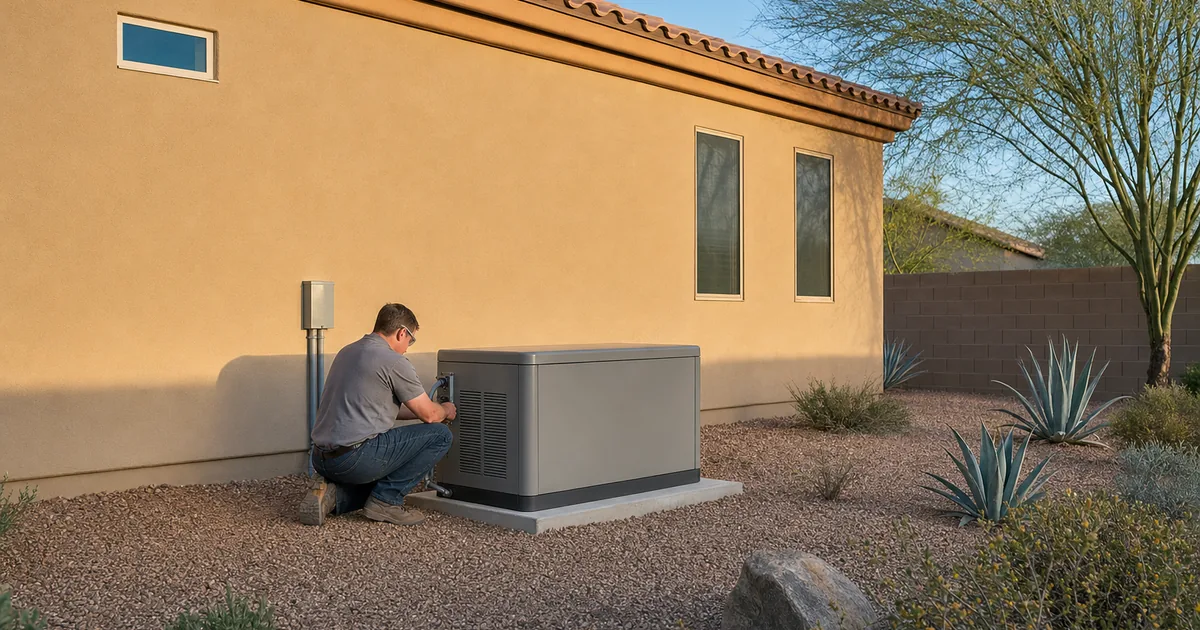
- Home standby generator. A permanently mounted unit on a pad, fueled by natural gas or propane and wired through an automatic transfer switch. It starts on its own when utility power fails and hands the house back to utility power when service returns.
The second and third setups connect a second power source to the house wiring, and that connection is where the safety rules concentrate. Every rule in this guide serves one of two goals: generator power must never reach the utility’s lines, and generator exhaust must never reach the inside of the house.
Deciding what has to run during an outage comes before choosing a size. When we plan a generator for a Mesa home, the first conversation is about which loads matter: refrigeration, some lights and outlets, any medical equipment, the garage door, and whether cooling has to run. That list, checked against the home’s actual loads, sets the size of the generator and of the transfer equipment. Cooling is the load that changes the answer most, because whole-house air conditioning needs far more generator than a few circuits do. The panel comes into it too; if the panel is full or the service itself is in question, see electrical panel upgrades in Mesa.
Do you need a permit to install a generator in Mesa?
For any generator that connects to the house, yes. The City of Mesa’s Energy Safety and Education page tells residents that when “installing customer-owned generation, always use qualified licensed contractors and obtain proper permits.” The City’s Residential Construction Homeowners Guide, dated March 2025, lists permit-required work that includes “New electric panels or subpanels, new system connections, relocated drain systems” and “Modifying existing load bearing, electrical, plumbing, or gas line systems.” In our reading, a transfer switch wired into the panel modifies the electrical system, and a new gas line to a standby unit modifies the gas line system.
The same guide says “All permitted residential projects require inspections at each stage of construction,” and that inspections are usually available the next working day, between 6:30 a.m. and 5:00 p.m., Monday through Friday. It also states that “All permit applications, plan review, documents, and approvals are electronic,” handled through the City’s DIMES system. Questions about a specific project go to City of Mesa Permit Services at 480-644-4273.
The electrical work is inspected under the Mesa Electrical Code. Mesa adopts the 2023 National Electrical Code with City amendments, and the City’s amendment document names the amended code the Mesa Electrical Code, with the Building Safety Director or designee as the authority having jurisdiction.
The City’s Development Services checklists do not include one written specifically for residential standby generators or transfer switches. The general permit rules above govern, and Permit Services is the place to confirm exactly what your submittal needs. A portable generator that only runs appliances on cords, with no connection to the house, is not named on the City lists cited here.
Why does a Mesa generator need a transfer switch?
Because without one, a generator connected to house wiring can push power backward through the meter onto the utility’s lines. That backfeed endangers line workers restoring service, and it can damage the generator and the home’s equipment when utility power returns. The National Electrical Code addresses it directly: as IAEI Magazine explains, the code requires transfer equipment installed “to prevent paralleling of the normal (Utility) and alternate (Generator) sources.”
SRP’s Electric Service Specifications, Section 1 (revised July 2021), put it in plain terms. They state that “Stand-by generators, alternate supply circuit or multiple service must not be interconnected with the SRP electric system,” and that “an open transition (break-before-make) transfer switching scheme is required.” Break-before-make means the switch disconnects the house from the utility before it connects the generator, so the two sources are never joined, even for an instant.
SRP names two kinds of equipment it accepts: a UL 98 listed double-throw safety switch, or “a UL 1008 listed transfer switch specifically designed for that purpose.” It requires that “Signage shall be permanently affixed to the exterior of the service entrance equipment,” showing that an on-site power source exists and where the transfer device is located, and it states that “SRP reserves the right to inspect and approve all installations.” A Mesa amendment points the same way on labels: the City’s amendment to section 230.70(B) says plastic tape is not durable material for marking a service disconnect, so markings at the service should be permanent.
The rule that matters most for a portable generator is the simplest one. SRP’s monsoon-preparedness advice says to follow the manufacturer’s instructions, use the generator only in a well-ventilated area, and “Never connect it to your building’s wiring.” Plugging a generator into a dryer or range outlet with a double-ended cord is exactly that connection. On Mesa calls we still find those cords stored next to portable generators, and they are the first thing we recommend replacing with a proper inlet and listed transfer equipment.
Does it matter whether your Mesa home is on City of Mesa Electric or SRP?
Yes, because each utility sets its own connection rules. Mesa homes are served by two electric utilities. City of Mesa Electric serves a total service area of 5.5 square miles around downtown, according to the City’s Electric Service Area map, and SRP serves the rest of the city. The City’s power outage page lists both: City of Mesa Electric customers report outages and downed lines at 480-644-2262 or 911, and SRP customers call 602-236-8888. The name on your electric bill is the quickest way to know which applies.
The transfer-switch rules quoted above come from SRP’s own specifications. We did not find a City of Mesa Electric document that sets out generator or transfer-switch rules for its customers, so this guide does not state any. If your home is in the City of Mesa Electric area, the contractor should confirm the utility’s requirements before equipment is ordered. A side-by-side of both utilities is on City of Mesa Electric and SRP explained.
A natural-gas standby generator adds a second utility question. The City of Mesa runs a gas utility, and its Homeowners Guide also lists Southwest Gas among the utility contacts for Mesa permits, so a Mesa address may be served by either. Mesa’s Residential Gas Piping Plan Submittal Checklist says new piping must start at a meter location approved by the gas utility, and for properties served by City of Mesa Gas it tells applicants to “contact gas engineering at 480-644-2509 for additional information.” The City also reminds owners that “Piping from the meter to every gas appliance, indoors and out, belongs to the property owner,” and a line run to a generator is part of that piping.
How many people die from generator carbon monoxide, and what does it mean for a Mesa home?
CPSC data put the risk in plain numbers. In a June 2022 report, the agency counted 814 carbon monoxide deaths associated with generators in the United States from 2011 through 2021, in 624 incidents, and about 71 percent of those deaths (581) happened at fixed-structure homes. CPSC cautions that “Due to incident reporting delays, statistics for the most recent years (2020 and 2021) should be considered incomplete.” These are national figures; no Mesa count is published.
| Year | Deaths (CPSC Table 3) | Share of 2011-2021 total (our arithmetic) | Data status |
|---|---|---|---|
| 2011 | 96 | 11.8% | Reported |
| 2012 | 49 | 6.0% | Reported |
| 2013 | 59 | 7.2% | Reported |
| 2014 | 49 | 6.0% | Reported |
| 2015 | 77 | 9.5% | Reported |
| 2016 | 75 | 9.2% | Reported |
| 2017 | 83 | 10.2% | Reported |
| 2018 | 76 | 9.3% | Reported |
| 2019 | 95 | 11.7% | Reported |
| 2020 | 103 | 12.7% | Incomplete (CPSC) |
| 2021 | 52 | 6.4% | Incomplete (CPSC) |
| Total | 814 | 100% | 624 incidents |
How we got this table. The yearly death counts come from Table 3 of the U.S. Consumer Product Safety Commission report on fatal non-fire carbon monoxide incidents from engine-driven generators and other engine-driven tools, 2011 to 2021, published in June 2022 with data as of May 10, 2022, read on November 26, 2026. The share column is our own arithmetic (each year divided by 814, rounded to one decimal). CPSC says the 2020 and 2021 counts are incomplete because of reporting delays. The data are national; CPSC does not publish a Mesa figure.
In a separate December 2025 safety release, CPSC states that “An average of about 100 consumers die in the U.S. each year from CO poisoning from portable generators.” That is CPSC’s own estimate in a different publication, built differently from the year-by-year incident counts above, so the two figures should not be compared directly. The same release says to “Operate portable generators outside only, at least 20 feet away from the house.”
Standby generators are not exempt. CPSC’s June 2025 study of home standby generators after the Hurricane Ida outages identified “105 homes in which the home’s stationary generator was identified specifically as the source of CO,” and residents had symptoms in 12 of them. CPSC concluded that “the 5 ft. enclosure-to-opening clearance allowed in NFPA 37 is inadequate,” recommended at least 25 feet, and recommended carbon monoxide alarms in all homes. The 25-foot figure is a CPSC recommendation, not a Mesa code requirement. For alarm placement, see smoke and carbon monoxide detectors in Mesa.
Where should a standby generator go on a Mesa lot?
Placement is a balance of five things in Mesa: distance from openings, the City’s screening rule, noise, the fuel line, and what lies underground.
- Distance from windows, doors and vents. Follow the manufacturer’s installation instructions for the model. CPSC’s 2025 study argues that the 5-foot clearance in NFPA 37 is not enough and recommends 25 feet from openings. On a narrow side yard that may not be achievable, and the closer the unit sits to the house, the more the carbon monoxide alarms inside matter.
- Screening. Mesa’s single-family zoning submittal checklist says “All exterior mechanical equipment, whether on roof, side of structure, or on ground shall be screened from public view,” followed by “Exception: AG, RS, DR-1 and RSL districts.” The checklist names air-conditioning equipment but does not name generators, so ask the City how it applies to your lot and zoning district.
- Noise. A standby generator runs a short exercise cycle on a schedule and can run for hours during an outage. Mesa has a noise ordinance, and Mesa Police take noise complaints at 480-644-2211, option 2. The police summary itself says, “This is a brief summary of the Mesa Noise Ordinance. Please read the full ordinance for what is and is not allowed.” This guide does not state decibel limits or hours, because the full ordinance text is not summarized here.
- Fuel. Mesa’s gas piping checklist calls for underground gas piping to be buried at least 12 inches deep (8 inches for individual outdoor appliances in protected locations), requires a direct-burial tracer wire on non-metallic pipe, keeps gas lines and propane tanks out of public utility easements, and places propane tanks at least 5 feet from buildings and property lines, with exceptions, with combustibles kept 10 feet away. It also requires applicants to “Include the BTU load for each appliance,” so the generator’s gas demand is added to the house’s existing appliances on the plan. The checklist does not mention generators by name.
- What is underground. The City says, “Always call 8-1-1 before you dig to have your utilities located,” and adds, “Contacting Arizona 811 is easy, free, and it’s the law.” A gas trench or a conduit run to a generator pad is digging.
On Mesa lots we often find that the spot that looks easiest, right beside the gas meter, sits under a bedroom window or against a side-yard wall where exhaust has nowhere to go. A spot a little farther out, with a longer gas run, is usually the better trade.
What are the steps of a home standby generator installation in Mesa?
The order of work matters more than the equipment brand. The matrix below sets out which documents touch each kind of generator setup in Mesa, and the steps after it show the sequence for a standby unit.
| Setup | What connects to the home | City permit (our reading) | Document behind it | Utilities involved |
|---|---|---|---|---|
| Portable generator on cords | Nothing; appliances plug into the generator | Not named on the City lists cited here | CPSC: outside only, at least 20 feet from the house; SRP: never connect to building wiring | None |
| Portable generator with inlet and transfer equipment | Selected house circuits through transfer equipment | Yes: modifies the electrical system | Homeowners Guide permit list; SRP ESS Section 1 (UL 98 or UL 1008, open transition, signage) | SRP or City of Mesa Electric (City Electric generator rules: Not given) |
| Natural-gas standby generator | Automatic transfer switch and a new gas line | Yes: electrical and gas line systems | Homeowners Guide; Residential Gas Piping Checklist (BTU load, meter location); SRP ESS Section 1 | Electric utility plus City of Mesa Gas or Southwest Gas |
| Propane standby generator | Automatic transfer switch, tank and piping | Yes: electrical and gas line systems | Residential Gas Piping Checklist (tank clearances, easements); SRP ESS Section 1 | Electric utility |
How we got this table. This matrix is our own arrangement of City of Mesa, SRP and CPSC documents listed under References, read on November 26, 2026. The permit column is our reading of the City’s Homeowners Guide permit list and its Energy Safety and Education page; the City publishes no generator-specific handout, so confirm your project with Permit Services. No City of Mesa Electric generator rule was found, so that cell reads Not given. The table contains no prices because no public source sets one.
- Decide what must run. List the loads that matter during an outage and check them against the home’s actual electrical loads. That sets the generator size and the transfer switch.
- Confirm both utilities. Read the electric utility off the bill, and for a gas unit confirm whether the address is on City of Mesa Gas or Southwest Gas.
- Pick the location. Measure to windows, doors and vents, check the screening rule for the zoning district, think about neighbors and noise, and call 811 before any digging.
- Submit the permits. The electrical work and the gas piping plan go in electronically through the City’s DIMES system; the gas plan carries the BTU load of every appliance, including the generator.
- Install. The pad, the fuel line, the transfer switch and the generator wiring go in, with permanent signage at the service entrance where SRP’s specifications call for it.
- Inspect, then test. The City inspects each stage. After approval, the system is tested by cutting utility power and watching the transfer switch move the house to the generator and back.
What should a written generator installation estimate list?
Estimates are only comparable when they describe the same scope. Ask each contractor to state the loads the system is designed to carry; the generator and the listed transfer switch it will be wired to; the proposed location and its distance from openings; who prepares and submits the electrical permit and the gas piping plan; who confirms requirements with the electric and gas utilities; whether panel work is needed to accept the transfer equipment; who handles trenching, the pad and any screening; and the contractor’s Arizona license number and classification. When two estimates differ widely, they usually differ on the gas run, the trenching and the panel work.
Portable generator or home standby generator: which fits a Mesa home?
The choice comes down to who is home during an outage, what has to keep running, and how much handling the household is willing to do.
A portable generator with transfer equipment suits a household that wants refrigeration, lights, internet and a few outlets during an outage and is willing to roll the generator out, refuel it and start it by hand. The installation is the inlet and the transfer equipment; the generator can be stored in the garage. Its weakness is the human step: during a monsoon storm someone has to set it up outdoors, well away from the house, in wind and rain. CPSC’s advice to run it outside only and at least 20 feet from the house is the line that cannot be bent, and an open garage door does not count as outside.
A home standby generator suits a household where power has to come back without anyone acting, such as a home where someone depends on powered medical equipment or where no one may be home to start a portable unit. It runs on piped natural gas or a propane tank, so refueling during a long outage is not a chore, and an automatic transfer switch handles the changeover. In exchange it needs a gas plan, a pad, a location that works for clearances and screening, and the most coordination of any option.
Either way, the size follows the load list. A system meant to run whole-house cooling is a much larger job than one that carries a few essential circuits, and in a Mesa summer that is the decision that shapes everything else. We find it helps to price both an essential-circuits design and a larger one, so the household can see what the extra capacity actually buys. Homes with a pool or spa should list that equipment too, and the wiring for it is covered on hot tub and pool wiring in Mesa.
What are the most common mistakes with generator installation in Mesa?
- Backfeeding through an outlet. A double-ended cord into a dryer or range outlet connects the generator to the building wiring, which SRP says never to do, and it can energize the utility’s lines.
- Skipping the permit. The City tells residents installing customer-owned generation to use qualified licensed contractors and obtain proper permits, and its permit list covers new system connections and changes to electrical and gas line systems.
- Placing the unit for convenience. CPSC’s standby-generator study found units close to openings poisoning homes; measure to windows, doors and vents before the pad is poured.
- Leaving the generator off the gas plan. Mesa’s gas piping checklist requires the BTU load of each appliance, and a generator added without that calculation can starve the other appliances on the line.
- Running a portable generator in the garage. CPSC says portable generators belong outside only, at least 20 feet from the house.
- No carbon monoxide alarms. CPSC recommends CO alarms in all homes, and a home with any fuel-burning generator is the clearest case for them.
Who installs home generators in Mesa?
Arizona licenses contractors through the Registrar of Contractors, and the City of Mesa’s own advice for customer-owned generation is to use qualified licensed contractors and obtain proper permits. A standby installation usually involves electrical work and gas piping, so ask how each part of the job is licensed and permitted before you sign. Before you hire anyone, ask for the license number and classification, who will submit the City of Mesa permits, and whether they have confirmed the transfer-switch requirements with City of Mesa Electric or SRP for your address. A contractor who does this work regularly can answer all three without looking anything up. A broader check of the home’s wiring before a generator is added is covered on home electrical inspections in Mesa.
Generator installations requested through Your Mesa Electrician are performed by Alvey Electric LLC, Arizona Registrar of Contractors license ROC 364723, a residential electrical contractor (R-11 Electrical, residential). The work is residential only.
Frequently asked questions
Do I need a permit to install a generator in Mesa?
Yes, for any generator connected to the house. The City of Mesa tells residents installing customer-owned generation to always use qualified licensed contractors and obtain proper permits, and its Homeowners Guide lists new system connections and changes to electrical and gas line systems as permit work. Permitted projects are inspected at each stage. A portable generator used only with extension cords is not named on those City lists. Questions go to City of Mesa Permit Services at 480-644-4273.
How much does generator installation cost in Mesa?
This page does not quote a price because no public source sets one. The cost depends on whether the setup is a portable unit with transfer equipment or a standby unit, the generator size the load list calls for, the type of transfer switch, the length of the gas or propane run and any trenching, the pad and any screening, and whether the panel needs work to accept the transfer equipment. A written estimate after a site visit is the reliable number.
Why does a Mesa generator need a transfer switch?
A transfer switch keeps generator power from flowing back onto the utility's lines. The National Electrical Code requires transfer equipment that prevents paralleling the utility and generator sources. SRP's Electric Service Specifications say standby generators must not be interconnected with the SRP system, require a break-before-make transfer scheme, and accept a UL 98 listed double-throw safety switch or a UL 1008 listed transfer switch.
Can I plug my generator into a dryer outlet to power my house?
No. SRP's advice on generators is to never connect one to your building's wiring, and a double-ended cord into a dryer or range outlet is exactly that connection. It can send power back onto the utility's lines and endanger line workers. If you want a portable generator to run house circuits, have a licensed contractor install an inlet and listed transfer equipment under a City of Mesa permit.
How far from the house should a generator be?
For portable generators, CPSC says to operate them outside only, at least 20 feet away from the house. For home standby generators, CPSC's June 2025 study concluded that the 5-foot enclosure-to-opening clearance in NFPA 37 is inadequate and recommended at least 25 feet. That 25-foot figure is a CPSC recommendation, not a Mesa code rule, so follow the manufacturer's instructions and keep the unit as far from openings as the lot allows.
Does a standby generator need to be screened from the street in Mesa?
Possibly. Mesa's single-family zoning submittal checklist says all exterior mechanical equipment on the roof, the side of the structure or the ground shall be screened from public view, with an exception for AG, RS, DR-1 and RSL districts. The checklist names air-conditioning equipment but does not name generators, so ask the City how the rule applies to your lot and zoning district before choosing a location.
Is my home on City of Mesa Electric or SRP, and does it matter for a generator?
Check the name on your electric bill. City of Mesa Electric serves a 5.5-square-mile area around downtown, according to the City's service area map, and SRP serves the rest of Mesa. It matters because each utility sets its own connection rules. SRP's written specifications cover generator transfer switches and signage; no City of Mesa Electric generator document was found, so the contractor should confirm that utility's requirements first.
Who do I call about the gas line for a natural-gas generator in Mesa?
First find out whether your address is served by City of Mesa Gas or Southwest Gas. Mesa's Residential Gas Piping Plan Submittal Checklist says piping must start at a meter location approved by the gas utility and lists gas engineering at 480-644-2509 for City of Mesa Gas properties. The plan must include the BTU load of each appliance, and the City says piping after the meter belongs to the property owner.
Can a standby generator cause carbon monoxide poisoning?
Yes. CPSC's June 2025 study of home standby generators after the Hurricane Ida outages identified 105 homes where the home's stationary generator was the source of carbon monoxide, and residents had symptoms in 12 of them. CPSC recommends at least 25 feet between the generator and openings and carbon monoxide alarms in all homes. Placement and alarms matter for standby units as well as portable ones.
What should I do if the power goes out in Mesa?
According to the City of Mesa's power outage page, City of Mesa Electric customers report outages and downed lines at 480-644-2262 or 911, and SRP customers call 602-236-8888. Stay well away from any fallen line. If you run a portable generator, keep it outdoors at least 20 feet from the house, as CPSC advises, and never connect it to the home's wiring without listed transfer equipment.
Who installs generators requested through Your Mesa Electrician?
Generator installations requested through Your Mesa Electrician are performed by Alvey Electric LLC, Arizona Registrar of Contractors license ROC 364723, R-11 Electrical, residential. The work is residential only. The City of Mesa advises residents installing customer-owned generation to use qualified licensed contractors and obtain proper permits, so ask any contractor for the license number and who will submit the permits.
The short version
Settle the connection and the location before the generator itself: listed transfer equipment that keeps power off the utility's lines, and a spot that keeps exhaust away from every opening. Confirm which electric and gas utilities serve the address, then let the City of Mesa permit, the gas plan and the staged inspections set the order of work. If a portable unit will do, the rule is outdoors, far from the house, and never into an outlet.
This page is general information about residential electrical work in Mesa, Arizona. It is not engineering, legal or code advice for a specific property. Permit rules, utility requirements and adopted codes change; confirm current requirements with the City of Mesa and your electric utility before work begins.
References
- City of Mesa, Amendments to the 2023 National Electrical Code (Mesa Electrical Code), including 80.1 and 230.70(B). Read November 26, 2026. https://www.mesaaz.gov/files/assets/public/v/3/business-development/devsvcs/codeamendments/2023-nec-amendment.pdf. Read November 26, 2026.
- City of Mesa, Energy Safety and Education (customer-owned generation, gas piping ownership, 811). Read November 26, 2026. https://www.mesaaz.gov/residents/energy/safety-education. Read November 26, 2026.
- City of Mesa, Residential Construction Homeowners Guide, March 2025. Read November 26, 2026. https://www.mesaaz.gov/files/assets/public/v/2/business-development/devsvcs/guides/residential-construction-guide.pdf. Read November 26, 2026.
- City of Mesa, Residential Gas Piping Plan Submittal Checklist. Read November 26, 2026. https://www.mesaaz.gov/files/assets/public/v/2/business-development/devsvcs/checklists/residential-gas-piping.pdf. Read November 26, 2026.
- City of Mesa, Single Family Homes Zoning Requirements Plan Submittal Checklist. Read November 26, 2026. https://www.mesaaz.gov/files/assets/public/v/4/business-development/devsvcs/checklists/zoning-requirements-for-single-family.pdf. Read November 26, 2026.
- Mesa Police, Noise Disturbance. Read November 26, 2026. https://www.mesaaz.gov/Public-Safety/Mesa-Police/Crime-Safety/Noise-Disturbance. Read November 26, 2026.
- City of Mesa, Power Outage. Read November 26, 2026. https://www.mesaaz.gov/Utilities/Power-Outage. Read November 26, 2026.
- City of Mesa, Electric Service Area map (total service area 5.5 square miles). Read November 26, 2026. https://gis.mesaaz.gov/energy/serviceareas/Electric_Service_Area.pdf. Read November 26, 2026.
- Salt River Project, Electric Service Specifications, Section 1 General, revised July 22, 2021 (p. 1-23). Read November 26, 2026. https://www.srpnet.com/v3/assets/bltefc1fc708dcc94e7/blt60f0e0173eae989e/ESS-section-1-general.pdf. Read November 26, 2026.
- Salt River Project blog, 5 ways to stay prepared during monsoons, April 28, 2026. Read November 26, 2026. https://blog.srpnet.com/5-ways-to-stay-prepared-during-monsoons/. Read November 26, 2026.
- U.S. Consumer Product Safety Commission, news release on carbon monoxide and fire safety tips, December 12, 2025. Read November 26, 2026. https://cpsc.gov/Newsroom/News-Releases/2026/As-Winter-Storms-Threaten-Millions-in-the-US-CPSC-Issues-Safety-Tips-to-Help-Families-Prevent-Carbon-Monoxide-Poisoning-and-Fires. Read November 26, 2026.
- U.S. Consumer Product Safety Commission, Fatal Incidents Associated with Non-Fire Carbon Monoxide Poisoning from Engine-Driven Generators and Other Engine-Driven Tools, 2011-2021, June 2022 (Table 3). Read November 26, 2026. https://www.cpsc.gov/s3fs-public/Fatal-Incidents-Associated-with-Non-Fire-Carbon-Monoxide-Poisioning-from-Engine-Driven-Generators-and-Other-Engine-Driven-Tools-2011-2021.pdf. Read November 26, 2026.
- U.S. Consumer Product Safety Commission, Stationary Generators: The Carbon Monoxide Poisoning Hazard and Recommendations for Mitigation, June 2025. Read November 26, 2026. https://www.cpsc.gov/s3fs-public/Report-on-stationary-gen-CO-hazard-FINAL.pdf?VersionId=.eQVnVwTG6boZF_f451Fd6zki2h2qNTG. Read November 26, 2026.
- IAEI Magazine, Chad Kennedy, Transfer Equipment Used in Optional Standby Systems for Commercial Applications, Part I, May 16, 2009. Read November 26, 2026. https://iaeimagazine.org/2009/may2009/transfer-equipment-used-in-optional-standby-systems-for-commercial-applications-part-i/. Read November 26, 2026.
Plan your generator setup
Request a load review and a written estimate for a generator at your Mesa home.
Related pages
About this page
Written by the Your Mesa Electrician editorial team from the sources listed above. Reviewed by Robert "Bob" Lira, licensed Arizona electrical contractor, ROC 338369. Your Mesa Electrician, 1740 S Robin Ln, Mesa, AZ 85204, phone 480-701-4348, serves homes in the City of Mesa. Electrical work is performed by Alvey Electric LLC, Arizona Registrar of Contractors license ROC 364723 (residential electrical).
Updated .